
Acupuncture vs. Massage: How to Choose for Pain and Recovery
For most people with sore muscles, a stiff back, or a body that needs to recover, massage is the better first step. It works directly on the tissue that hurts, you feel the effect in the session, and trials show it lowers pain as much as acupuncture does. Acupuncture is a reasonable option too, and the two are not rivals. This guide explains how each works, what the research says, and how to pick for your situation.
TL;DR
- Massage manipulates muscles and other soft tissue. Acupuncture stimulates specific points, most often with thin needles.
- In a 2023 randomized trial, both reduced pain, and massage reduced it slightly more, though the gap was not statistically significant.
- For back pain, a major physicians’ guideline lists massage and acupuncture as appropriate starting options, with massage showing the stronger short-term gains for subacute pain.
- Side effects of both are mild. Massage can leave you sore for a day, and acupuncture can cause bruising at needle sites.
- If your pain is muscular, or you want recovery and relaxation, start with massage. You can add acupuncture later if you like.
Table of Contents
- What each treatment actually is
- What the head-to-head trial found
- Back pain: what the evidence says
- Athletes and recovery: where massage fits
- Side effects and safety
- Which should you try first?
- Cost and coverage
- Our perspective
- Book a session in Austin
- FAQ
- Sources
What each treatment actually is
The National Center for Complementary and Integrative Health (NCCIH), part of the National Institutes of Health, describes acupuncture as stimulating specific points on the body, most often by inserting thin needles through the skin. It describes massage as manipulating the body’s soft tissues to help manage a health condition or improve wellness.
In practice, that gives you two very different appointments.
Massage is hands-on work on muscle, fascia (the connective tissue that wraps muscle), and tendon. The therapist presses, kneads, and stretches, and you tell them in real time whether the pressure is right. Swedish massage uses long, flowing strokes for relaxation. Deep tissue works slower and firmer into stubborn tension. Sports massage targets the muscles you train. Trigger point work focuses on knots that refer pain elsewhere, such as a shoulder knot that feeds a headache.
Acupuncture is done by a licensed acupuncturist. You lie still while very fine needles are placed at chosen points and left in for a period. There is no kneading of the muscle. In the U.S., acupuncture is usually delivered by non-physician providers who are licensed or regulated in most states, according to a review by Sherman and Coeytaux. Check your state’s licensing rules before booking.
How they are thought to work
A 2022 narrative review of sports-injury treatments explains the proposed mechanisms in modern-medicine terms. Electroacupuncture is thought to relieve muscle-strain pain by prompting the brain to release pain-dampening chemicals, including endogenous opioids. Massage is described as regulating the nervous, endocrine, and immune systems through sensory stimulation, with endorphins, serotonin, and other chemicals linked to its pain-relieving effect.
You don’t need the biochemistry to choose. The practical difference is that massage changes how your muscles feel and move, often within the hour. Acupuncture usually asks for a series of visits before you can judge it.
What the head-to-head trial found
The best direct comparison is the IMPACT trial, a randomized clinical trial published in 2023 at U.S. cancer centers. It enrolled 298 patients with advanced cancer pain and compared acupuncture with massage over 26 weeks.
- Acupuncture lowered worst pain by an average of 2.53 points.
- Massage lowered it by an average of 3.01 points.
- The difference between the two groups was not statistically significant.
- Both groups also improved on fatigue, insomnia, and quality of life.
The patients were dealing with serious illness, so this isn’t a direct match for a desk worker with a tight neck. It still shows that when the two are compared fairly, massage holds its own, and it gives you a sense of scale: a three-point drop on a ten-point pain scale is a change people notice.
Back pain: what the evidence says
Low back pain is the most common reason people ask this question. A 2020 federal evidence review from AHRQ found that about 28% of U.S. adults reported low back pain in the previous three months, more than any other pain site.
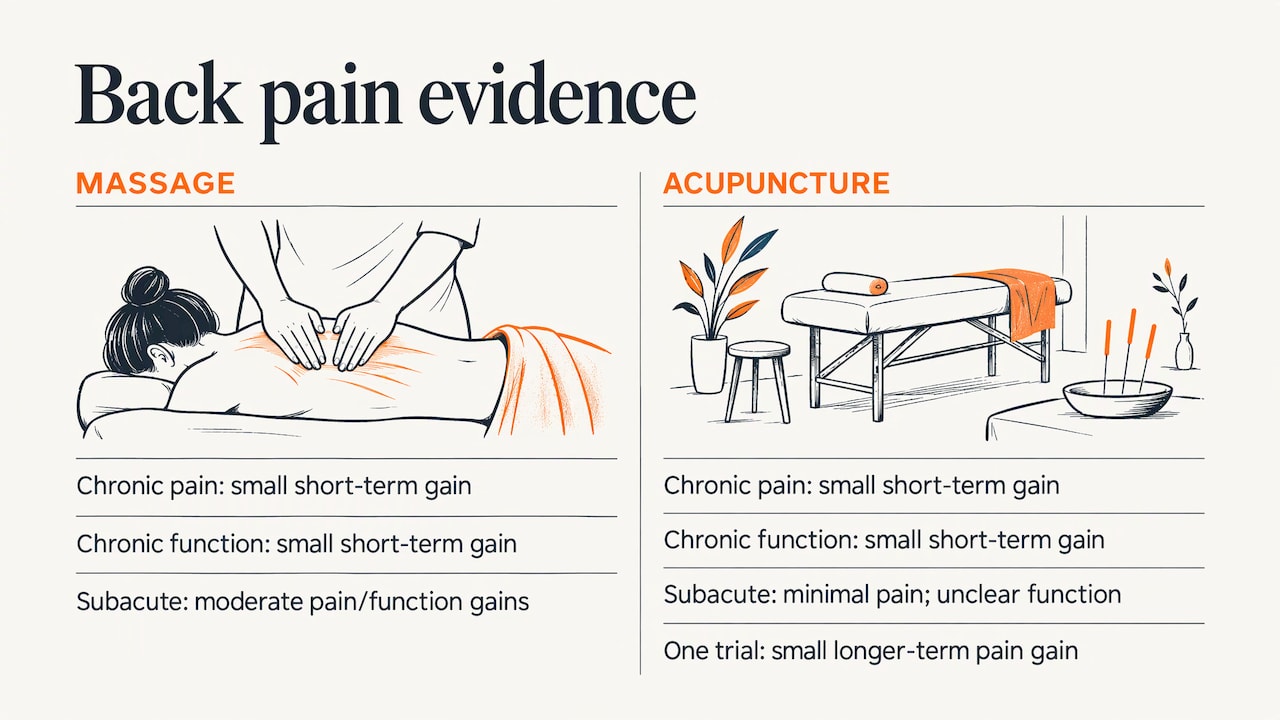
For chronic low back pain, the same review found that massage was linked to small short-term improvements in both pain and function compared with sham massage or usual care. Acupuncture was linked to small short-term improvements in pain and function too, with one trial showing a small longer-term pain benefit.
For newer back pain, the picture favors hands-on care. The American Academy of Family Physicians’ summary of the American College of Physicians guideline says that because acute and subacute low back pain often resolve on their own, heat, massage, acupuncture, and spinal manipulation are all appropriate initial options. It reports that massage produced moderate short-term improvement in pain and function in subacute pain, while acupuncture produced only minimal pain improvement and no clear function gain.
NCCIH also reports modest benefit from acupuncture for acute low back pain and moderate benefit for chronic low back pain, drawing on a 2017 evaluation of 49 studies. So acupuncture has real support, and no one is telling you to rule it out. The takeaway is that massage is a well-supported starting point and a sensible one when your back feels tight, stiff, or knotted. If that sounds like you, our guide to massage for back pain covers what helps and when to book, and QL release massage explains one common source of low back ache.
How long relief lasts
Neither treatment is a one-visit fix for long-standing pain. Both show their clearest benefits in the weeks after treatment. That’s why a plan matters more than a single appointment: a short series, then a check on how your body is responding. For ongoing pain, our chronic pain guide lays out how to start and how to pace sessions.
Athletes and recovery: where massage fits
If you train, you want to know which tool gets you back to training sooner. The 2022 sports-injury review found that acupuncture can ease fatigue and pain and help tissue recover, and that it should be performed by a qualified acupuncturist. It found that massage helps reduce pain and restore normal muscle activity in injured muscles, ligaments, and tendons, and that it has high safety and few side effects.
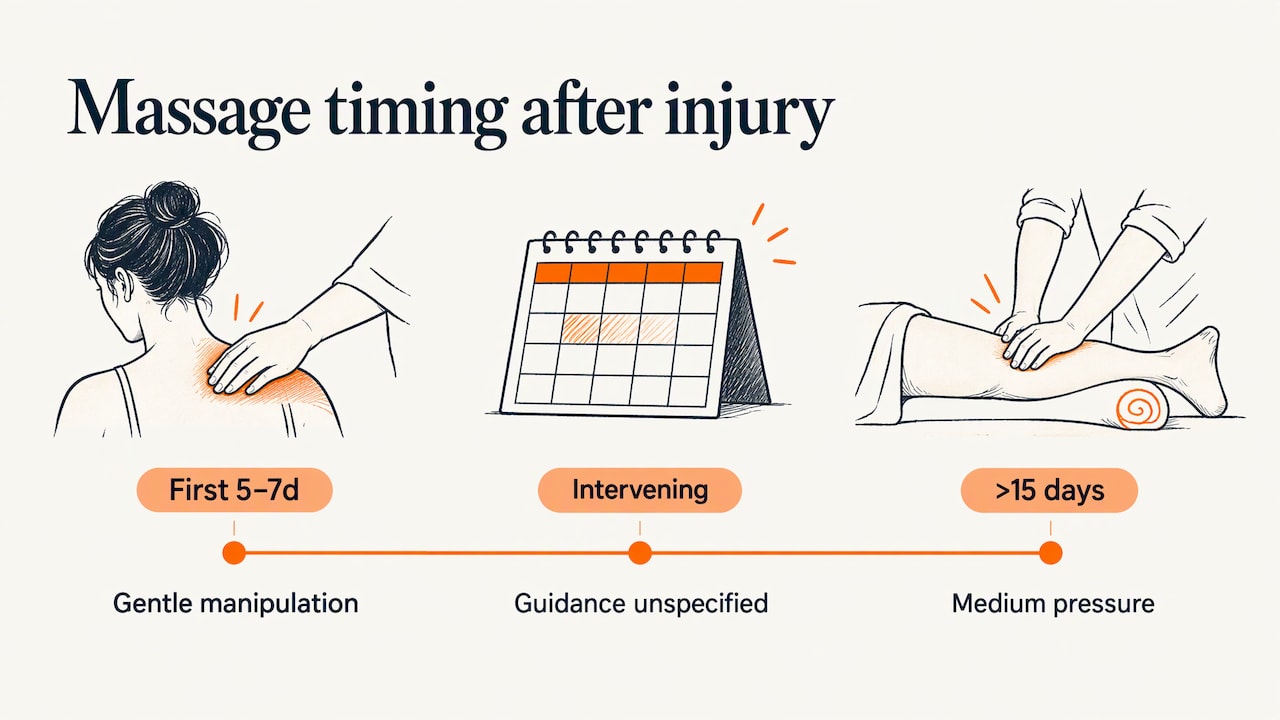
The same review gives one timing rule worth knowing. Massage too soon after an injury can cause secondary bleeding in the tissue. It advises only gentle manipulation for the first 5 to 7 days after an injury, and medium-intensity work after more than 15 days. A good therapist asks when the injury happened and adjusts pressure to fit. Tell yours about any recent strain, sprain, or tear before the session starts.
For day-to-day training load, massage has an obvious advantage: it is built for muscles that are tight from repetition. Our pages on sports massage, massage for runners, and deep tissue versus sports massage go into the specifics.
Side effects and safety
Both are low-risk when done by a qualified provider. In the IMPACT trial, side effects were mild in both groups.
| Acupuncture | Massage | |
|---|---|---|
| Most common | Bruising (6.5%), localized pain (5.8%), bleeding (1.4%) | Temporary soreness (15.1%), headache (1.4%) |
| What it feels like | A brief sensation at needle sites | A day of tenderness, like after a workout |
| Who delivers it | A licensed acupuncturist | A licensed massage therapist |
A state medical society reference on pain rehabilitation notes that acupuncture has few complications when sterile needles are used properly, and that massage carries low risk, with rare reports of serious problems such as a blood clot or fracture.
Please tell your massage therapist, before the session, if you have any of these:
- A blood clotting condition, deep vein thrombosis, or you take blood thinners
- Osteoporosis or a recent fracture
- A fresh injury, such as a torn ligament or muscle
- Pregnancy
If any of these applies, check with your doctor first. For a suspected torn ligament, get it evaluated by a physician before any hands-on work on the area. Numbness, weakness, or pain that radiates down a limb also deserves a doctor’s visit. Our page on pinched nerve massage explains when to wait.
Which should you try first?
The Sherman and Coeytaux review concluded that acupuncture is a reasonable option, particularly for people who prefer it or want to limit pain medication, and that it can be part of a multi-therapy plan. That points to the honest answer: the two can sit side by side. If you’re picking one to start, match it to the problem.
| Your situation | Start with |
|---|---|
| Tight, knotted muscles from desk work or training | Massage |
| Low back or neck stiffness that comes and goes | Massage |
| Muscle soreness after hard training | Massage |
| Headaches that start in the neck and shoulders | Massage with trigger point work |
| You want to unwind and sleep better | Massage |
| You want to try a needle-based approach, or are avoiding medication | Acupuncture with a licensed acupuncturist |
Two more practical reasons favor massage first. You control the experience: pressure, areas, and pace are adjustable during the session. And the feedback is immediate, so you know within one or two visits whether it’s helping.
If you’re unsure whether your problem calls for massage or a different clinical approach, our comparison of physical therapy vs. massage helps you sort it out.
Cost and coverage
Coverage differs. Many health plans cover acupuncture only for certain conditions, if at all, and the pain-rehabilitation reference above advises patients to check their health plan, since complementary approaches may not be covered. Seniors can read about Medicare coverage for acupuncture to see the rules and limits.
For massage at Howdy Massage, session prices are published: Swedish and deep tissue run $120 to $245, and sports massage runs $120 to $145. Trigger point therapy and stretching and joint mobilization have no published price on our services page.
Our perspective
When someone asks us whether to try acupuncture or massage, we start with what hurts and what they want from the session. Most people who come to us carry tension in the neck, back, hips, or legs, and that is the territory where hands-on work does its best job.
What we care about most is communication. A session shouldn’t be something done to you. You tell us when the pressure is too much or not enough, and we adjust, because comfort and trust decide whether a body lets go. Our work draws on a healthcare background and athletic experience, and it’s built around your goals, whether that’s relief from chronic pain, recovery from training, or an hour to relax.
We think the research supports starting with massage for muscular pain. If you also want to try acupuncture, we see no conflict. Use both, and let your own results guide the plan.
Operations
Book a session in Austin
Howdy Massage offers Swedish, deep tissue, sports, and trigger point massage in Austin, in our studio or at your location. Sessions are tailored to your pain, your training, or your need to unwind, and your therapist, Rick Snider, adapts the work as you give feedback. See the options and prices on our massage services page.
Not sure which style fits? Read Swedish vs. deep tissue or our guide to choosing a massage therapist in Austin.
FAQ
Is acupuncture or massage better for back pain?
Both have support. For subacute back pain, the American College of Physicians guideline summary reports moderate short-term gains in pain and function from massage, and only minimal pain improvement from acupuncture. For chronic back pain, both show small to moderate benefits. If your back feels tight and knotted, massage is a natural first choice.
Is it better to get acupuncture or a massage first?
For muscle tension, soreness, or stress, start with massage. You get feedback within a session or two and can adjust pressure as you go. If you’re drawn to acupuncture or want to avoid pain medication, a licensed acupuncturist is a reasonable option, and you can combine the two.
Is there any downside to acupuncture?
Side effects are usually mild. In the 2023 IMPACT trial, the most common were bruising (6.5%), localized pain (5.8%), and minor bleeding (1.4%). Choose a licensed provider who uses sterile needles. Massage also has mild effects: temporary soreness was reported by 15.1% of participants.
Is it okay to massage a torn ligament?
Not right away. Massage soon after an injury can cause bleeding in the tissue, and research advises only gentle work for the first 5 to 7 days. See a doctor to confirm the injury first, then tell your therapist so they can work around the area at the right intensity.
Sources
- NCCIH: Low-Back Pain and Complementary Health Approaches
- IMPACT trial: Acupuncture vs Massage for Pain in Patients Living With Advanced Cancer (2023)
- Effects of Acupuncture, Moxibustion, Cupping, and Massage on Sports Injuries (2022)
- AHRQ: Noninvasive Nonpharmacological Treatment for Chronic Pain (2020)
- Sherman and Coeytaux: Acupuncture for Improving Chronic Back Pain, Osteoarthritis, and Headache (2009)
- AAFP: Low Back Pain, American College of Physicians Practice Guideline (2017)
- Addressing Pain in South Carolina, pain rehabilitation reference
- Medicare coverage for acupuncture