
Massage for DOMS: What Helps and When to Book
Massage is one of the better-supported ways to take the edge off delayed onset muscle soreness (DOMS), the deep ache that shows up a day or two after a hard workout. Pooled studies find less soreness at 24, 48 and 72 hours, and the sweet spot for a session is either soon after training or a day or two later, once you can tell what is actually tight. In Austin, a licensed therapist can match the pressure and technique to how sore you are on the day. That is hard to do on your own when the muscle is already tender.
TL;DR
- A 2017 meta-analysis of 11 studies found massage reduced soreness at 24, 48 and 72 hours after intense exercise.
- A 20 to 30 minute massage right after exercise, or within about 2 hours, was linked to less soreness for 24 hours in a 2018 review. A session a day or two later also works well.
- Peak DOMS usually lands 48 to 72 hours after the workout, so a lighter session early and a fuller one later is a sensible plan.
- Pressure should follow how sore you are. Tell your therapist where it hurts and go lighter on the worst spots.
- Sharp, sudden or worsening pain is not DOMS. Get it checked by a doctor before booking massage.
Table of Contents
- What DOMS is, and how it differs from an injury
- What the research shows about massage and DOMS
- When to get a massage after a workout
- Which type of massage fits DOMS
- Getting the most out of a post-workout session
- Safety: when to wait or get checked
- What else eases DOMS alongside massage
- Massage for DOMS in Austin
- Our view on massage for DOMS
- FAQ
- Sources
What DOMS is, and how it differs from an injury
DOMS is the stiff, achy soreness that builds after exercise your body is not used to, especially movements where the muscle lengthens under load, like lowering a weight, running downhill or the first squat session in months. A 2025 review describes it as a type of microscopic muscle injury from eccentric contractions. It begins 6 to 12 hours after exercise, peaks between 48 and 72 hours, and fades by 5 to 7 days.
That timeline is your first test for telling DOMS from something else:
- DOMS feels like: a dull, widespread ache in the muscle belly, tender to press, worse when you stretch or use the muscle, and it improves as the days pass.
- A possible injury feels like: sharp or pinpoint pain, pain that started during the workout, swelling or bruising, a joint that feels unstable, or pain that gets worse instead of better.
UW Medicine says DOMS can last from a few days to a couple of weeks and should slowly improve. If it does not, a doctor should evaluate you for a sprain or strain. If you are not sure which one you have, see a doctor first. Massage is for soreness, not for a suspected tear.
What the research shows about massage and DOMS
Several large reviews point the same way on soreness.
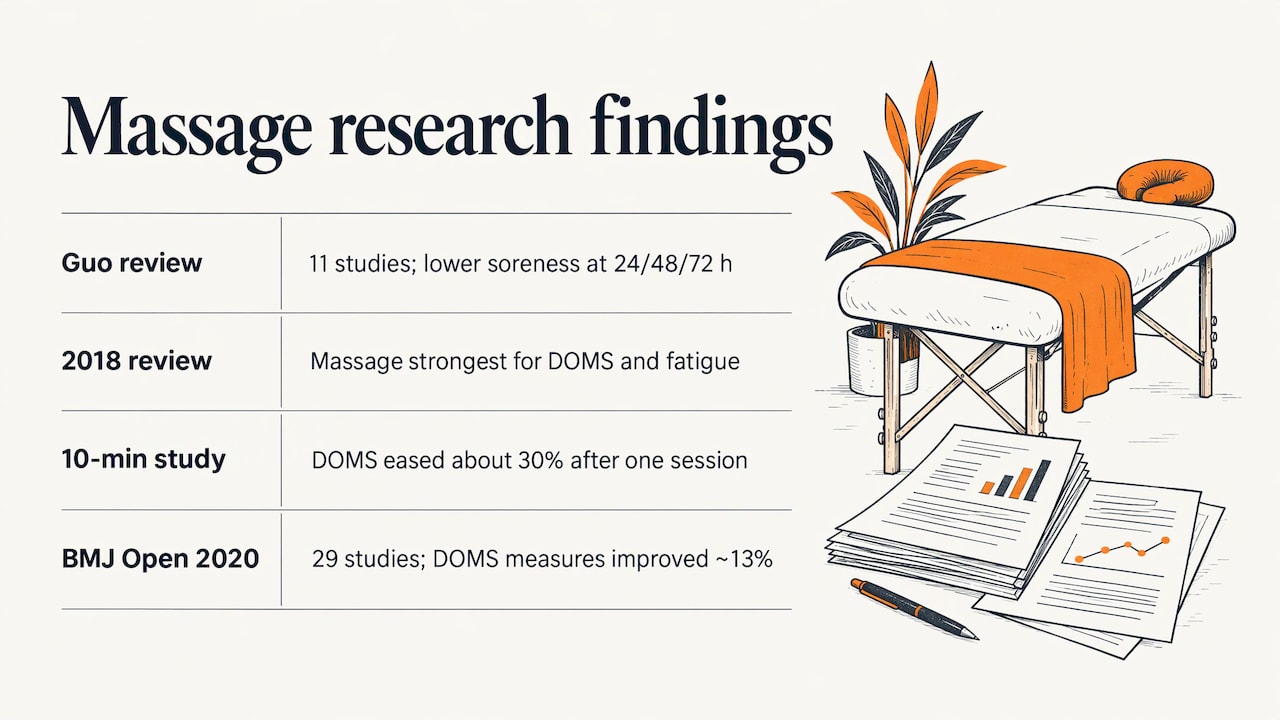
Soreness at 24, 48 and 72 hours. Guo and colleagues pooled 11 studies with 504 participants and found massage significantly decreased muscle soreness at 24, 48 and 72 hours after intense exercise. The effect was larger at 48 and 72 hours, which is when DOMS is at its worst. The same review reported lower levels of creatine kinase, a blood marker that rises after muscle damage.
Fatigue and inflammation markers. A 2018 systematic review with meta-analysis by Dupuy and colleagues compared recovery methods and found massage was the most powerful technique for recovering from DOMS and perceived fatigue. Massage and cold exposure were the most effective for reducing inflammation markers.
A single short session. In a controlled study, just 10 minutes of massage three hours after hard eccentric exercise eased DOMS by about 30% and reduced swelling in the upper arm at three and four days.
Sports massage specifically. A 2020 meta-analysis in BMJ Open covered 29 studies and 1,012 participants. It reported about a 13% improvement in DOMS measures and small gains in flexibility. The authors suggest that sports more likely to cause DOMS, especially multi-day events where you must perform again before soreness clears, have the most to gain.
Why it feels good
Researchers think the relief may come from effects on swelling and inflammation, or from systemic and pain-dampening effects, as laid out in a 2026 review of massage mechanisms. The same review notes that human evidence favors modest reductions in DOMS sensations, larger at 48 and 72 hours than at 24. UW Medicine’s team makes a similar point about recovery tools in general: massage, gentle movement and heat or cold made people feel better while the soreness ran its course. If you want to move, sleep and train more comfortably in the middle of a rough week, that is a real benefit.
When to get a massage after a workout
There are two sensible windows, and they serve different goals.
Soon after exercise (within about 2 hours)
The 2018 review found that a 20 to 30 minute massage immediately after or up to 2 hours after exercise reduced DOMS for 24 hours, with significant effects measured up to 96 hours. If you train close to where you book, this is the window to use. The American Massage Therapy Association’s journal describes post-event sports massage as typically 10 to 20 minutes when done soon after activity, and one therapist there suggests waiting about 30 minutes after an event ends so the athlete’s condition can be assessed first.
Keep pressure light to moderate here. The muscles are freshly worked and the real soreness has not arrived yet.
A day or two later (24 to 72 hours)
This is when DOMS peaks, and it is when many people actually feel like booking. The same AMTA article notes post-event massage can be more effective a day or two later. A therapist in it explains that hard exercise raises blood flow and adrenaline, which can mask problems, so it can take 24 to 48 hours to know which muscles are truly short and tight. A later session lets the therapist find those areas and work them with more precision.
For timing your sessions around your training week, this guide on how massage timing affects soreness is a good companion read.
A simple plan
| Situation | Suggested timing | Pressure |
|---|---|---|
| Long run, race or tournament day | Within 2 hours, if you can fit it in | Light to moderate, 20 to 30 minutes |
| Heavy leg day, first hard session in months | 24 to 48 hours later | Moderate, focus on the sorest areas |
| Soreness at its peak, hard to move | 48 to 72 hours later | Light to moderate, broad and gentle |
| Multi-day event or back-to-back training | Between days, as early as possible | Light, recovery-focused |
Which type of massage fits DOMS
Swedish, sports and deep tissue massage are all used for post-exercise soreness. What matters more than the label is the pressure and where the work goes.
- Swedish massage: long, gliding strokes and kneading at light to moderate pressure. It suits the first days of heavy DOMS, when anything firm feels like too much. See our guide to what a Swedish massage involves.
- Sports massage: targeted work on the muscles you trained, often with stretching and joint movement, planned around your training or event. Our overview of what sports massage is walks through a typical session.
- Deep tissue massage: slower, firmer work on deeper layers and stubborn tight spots. It fits best once the sharpest tenderness has settled, or for the knotty areas that stay tight between workouts. If you want to compare, here is how Swedish and deep tissue differ. And if you have had a tender day after a firm session before, read why you can feel sore after deep tissue massage and how to plan around it.
Trigger point work can help when one spot stays knotted well after the general soreness has gone. Training for a specific sport? We have pages written for runners, cyclists and weightlifters.
Getting the most out of a post-workout session
- Say what you did. Tell your therapist the workout, when it happened and where you feel it. “Heavy squats yesterday, quads and glutes” is more useful than “I’m sore.”
- Rate the soreness honestly. DOMS tenderness can feel much worse under pressure than it does at rest. Speak up in the moment, and the therapist can adjust. A session that stays comfortable is better than one you brace through.
- Choose pressure to match the day. Earlier and sorer means lighter. Later and calmer means you can go firmer.
- Mention anything unusual. Sharp pain, numbness, swelling, or pain that began mid-workout is a reason to pause and see a doctor first.
- Plan the next 24 hours. Drink water, walk a little, and go easy on the trained muscles. Mild tenderness after a firm session is common and usually settles in a day or so.
Safety: when to wait or get checked
Massage for ordinary soreness has a good safety record. A 2008 systematic review of 27 studies, summarized in a later PMC review, found no adverse effects from massage therapy in any of them. Still, a few situations call for caution:
- Suspected injury. Reviews caution that massaging injured tissue right after a muscle-damaging session may lead to further muscle damage. If something felt like a pull, pop or tear, see a doctor before booking.
- Soreness that is not improving. DOMS should ease over days. If it does not, get it evaluated for a sprain or strain.
- Health conditions. Commentary on roller massage lists precautions that also make sense to raise with any therapist: hypertension, osteopenia, pregnancy, diabetes, varicose veins, recent injury or surgery, and medications that alter sensation. Tell your therapist about any of these before you start, and check with your doctor if you are unsure.
- Severe, dark-urine, or swollen-limb symptoms after extreme exertion. That is a medical emergency, not soreness. Seek urgent care.
What else eases DOMS alongside massage
Massage works best as one part of a routine. UW Medicine lists active recovery such as walking, gentle yoga or easy swimming, stretching, gentle massage, and hot or cold therapy. Cold is used to reduce inflammation and heat to increase blood flow and ease stiffness. The 2025 review adds that cold is most useful in the acute phase, while heat suits the period after peak soreness has passed.
Sleep matters too. Here is a look at sleep and muscle recovery if your soreness keeps lingering during heavy training blocks.
One practical point: the best way to avoid brutal DOMS is to ramp up gradually. Add volume and new movements in small steps and the peak will usually be milder.
Massage for DOMS in Austin
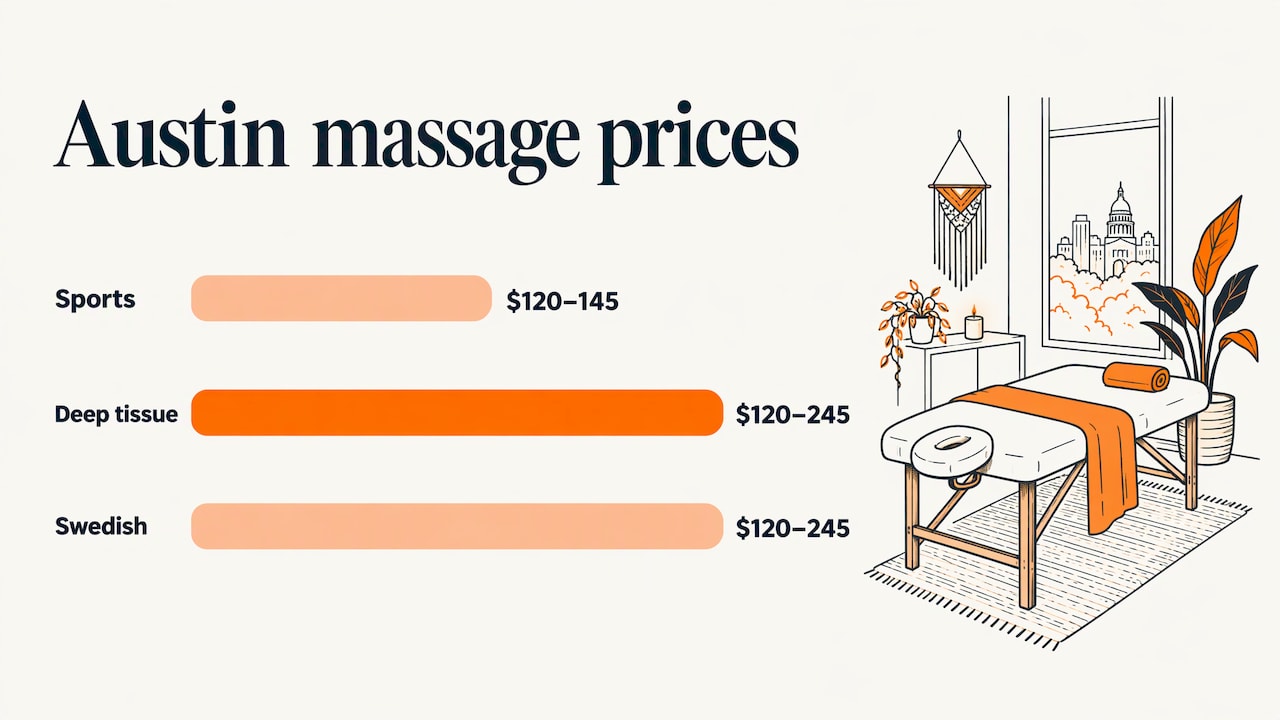
Howdy Massage offers sports, deep tissue and Swedish massage in Austin, in the studio or at your location. Published prices are $120-$145 for sports massage, and $120-$245 for deep tissue and for Swedish. Trigger point therapy and stretching with joint mobilization are also offered. Rick Snider, our licensed therapist, draws on a healthcare background and his own athletic experience, and keeps communication open through the session so pressure stays where you want it. That is exactly what a sore, tender muscle needs.
Browse the massage services we offer in Austin or read about sports massage therapy in Austin to pick a session that fits your week.

Booking a mobile session is handy right after a hard workout, because the therapist comes to you and you do not have to drive on sore legs.
Our view on massage for DOMS
We think of DOMS massage as a conversation more than a technique. Two people can do the same workout and feel completely different the next day, and the same person can feel different from one week to the next.
That is why we start every session by asking what you did, where it hurts and how firm you like it. We adjust as we go. A heavy-handed approach on a muscle at peak soreness is not what helps, and a good session should leave you feeling looser, not beaten up.
The research supports what clients tell us: massage can reduce the soreness you feel in the days after hard exercise, and it fits well beside walking, sleep and heat or cold. We build sessions around that. Lighter and broader when you are very sore, more focused work when the sharpest tenderness has passed, and stretching or joint mobilization when stiffness is the main complaint.
Our approach is shaped by Rick’s healthcare background and his years of athletic training. If something sounds like an injury rather than soreness, we will say so and point you to a doctor.
Operations
FAQ
Does massage help DOMS?
Yes, for soreness. Meta-analyses report reduced soreness at 24, 48 and 72 hours after hard exercise, with the largest differences at 48 and 72 hours. Many people also find it easier to move and sleep while the soreness runs its course.
Is it good to get a massage when sore from working out?
It usually is, as long as the pressure matches how sore you are. Go lighter on the first days and firmer later. Tell your therapist about any sharp pain or swelling, since that points to an injury and not DOMS.
How long after a workout should I get a massage?
Research points to two windows. One is within about 2 hours of finishing, for a short 20 to 30 minute session. The other is 24 to 72 hours later, when soreness peaks and a therapist can find exactly which muscles are tight.
Can you massage a sore muscle too much?
Too much pressure or too many sessions packed together can leave you more tender than before, so keep sessions comfortable and spaced out. Avoid massaging anything you suspect is torn or strained, and see a doctor if pain is sharp or not improving.
Sources
- Massage Alleviates Delayed Onset Muscle Soreness after Strenuous Exercise (Guo et al., Frontiers in Physiology, 2017)
- An Evidence-Based Approach for Choosing Post-exercise Recovery Techniques (Dupuy et al., 2018)
- Effects of Massage on Delayed-Onset Muscle Soreness (Zainuddin et al.)
- Effect of sports massage on performance and recovery (BMJ Open Sport & Exercise Medicine, 2020)
- Mechanisms and Efficacy of Massage Therapy (Tiidus, 2026)
- Post-Event Sports Massage (AMTA Massage Therapy Journal, 2020)
- Why Are My Muscles Sore Days After Working Out? (UW Medicine, 2023)
- Thermal Modalities Including Hot Baths and Cold Plunges (2025 review)
- Does Massage Help Athletes After Exercise? (PMC, 2020)
- Roller Massage: A Commentary on Clinical Standards and Safety (2018)