Massage for Runners: What Helps and When to Book
Massage helps runners most with soreness, tight muscles and the feeling of being beaten up after hard training. The research on it is more modest for speed and endurance. The best fit is a session after hard efforts, with pressure matched to the day. Use lighter work near a race and deeper work in the middle of a training block. Below you’ll find what the studies show, which massage type suits which situation, how to time sessions around long runs and marathons, and what to tell your therapist.
TL;DR
- Massage after hard exercise is linked to less muscle soreness. Evidence that it makes you faster or stronger is weak, so book it for recovery and comfort.
- Sports massage suits most runners. Swedish suits an easy recovery week, and deeper or trigger point work suits stubborn tight spots.
- Keep pressure light close to a race. After a marathon, go gentle and wait at least a day.
- Good massage should not be agony. Speak up during the session, and see a sports medicine physician before massage if you suspect an injury.
Table of Contents
- What massage can do for runners, according to the research
- Which type of massage suits which kind of running
- When to book: timing around your runs
- What a good session feels like, and what to tell your therapist
- When to see a doctor before booking
- What to do around your massage
- Perspective: why we treat runners as a training partner
- Book massage for runners in Austin
- FAQ
- Sources
What massage can do for runners, according to the research
The honest summary: massage is a recovery tool, not a performance booster. A 2020 meta-analysis of 29 studies and 1,012 participants found no evidence that sports massage improves strength, jumping, sprinting, endurance or fatigue. It did find small but statistically significant gains in flexibility (7%) and delayed-onset muscle soreness, or DOMS (13%).
Soreness is where the evidence is most consistent:
- A 2017 meta-analysis of 11 studies and 504 participants found that massage after strenuous exercise lowered soreness ratings at 24, 48 and 72 hours, and improved muscle function and peak torque.
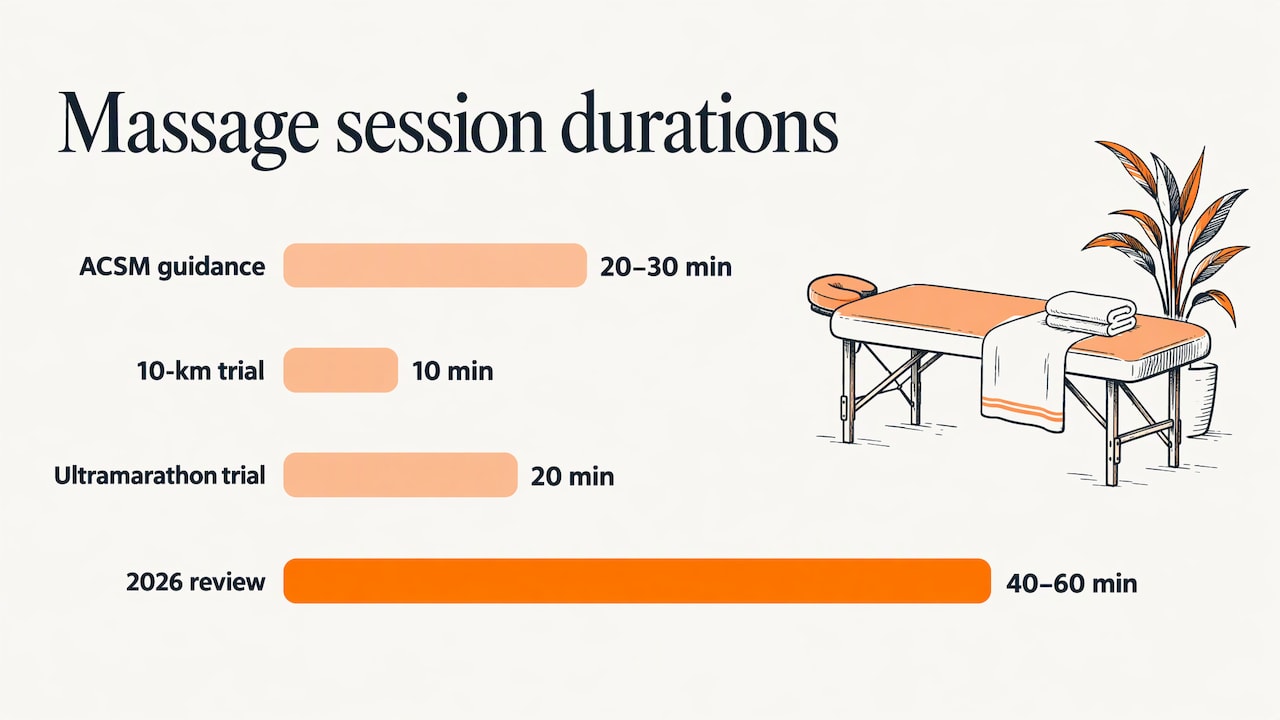
- According to the American College of Sports Medicine, as cited by Mayo Clinic Press, massage after a tough workout may reduce soreness, pain, inflammation and perceived fatigue. The ACSM suggests sessions of at least 20 to 30 minutes, ideally after the workout.
- In a randomized trial of 78 runners after a 10-km run, 10 minutes of quadriceps massage lowered pain by 0.7 points on a 0-to-10 scale compared with sham. It had no significant effect on fatigue, flexibility, strength or jumping.
- In a 2016 trial of 72 ultramarathon runners, a 20-minute post-race massage lowered muscle pain and soreness right after treatment compared with resting. There were no differences between groups from 1 to 7 days later.
There is also a note of caution for endurance athletes. An umbrella review covering 63 studies and 1,100 endurance athletes found no effect of massage on training recovery overall. So the realistic promise is that you feel better sooner, and that you get a regular check-in on your legs. It is not a shortcut to a personal best.
A 2026 review of 47 studies with 3,284 participants, published in IGI Active in, reported reduced pain and improved range of motion with massage. Its authors found deep tissue work reduced pain more than Swedish, sports or myofascial techniques. Sessions of 40 to 60 minutes every other week were associated with the best outcomes. That is a pooled result across many sports, not a runner-specific prescription, but it is a useful starting point for planning.
If you also use other recovery tools, such as heat or light-based devices, this page on sports injuries and recovery covers that side of the picture. Massage and those tools can sit side by side in a recovery routine.
Which type of massage suits which kind of running
The label matters less than what the session is for. Runner-focused work usually concentrates on the lower body: calves, hamstrings, quads, glutes, hips and feet.
| Massage type | Best for runners when | Typical feel |
|---|---|---|
| Sports massage | You are in a training block, building for a race, or need maintenance | Focused on the muscles you load most, adjustable pressure |
| Deep tissue | You carry chronic tightness in calves, glutes or hips between hard efforts | Slow, firm work on deeper layers |
| Swedish | After a heavy week or a race, when you mostly need to unwind and move blood | Long, flowing strokes at light to medium pressure |
| Trigger point | A specific knot keeps flaring up, such as a calf or glute spot | Sustained pressure on one point, then release |
This lines up with how Runner’s World describes the options. Sports massage covers rehab, pre- and post-race support and maintenance. Swedish suits general stress reduction and circulation after a tough week. Trigger point and neuromuscular work suit chronic pain issues and mobility.
Sports massage for runners
This is the default choice if you run several days a week. A sports massage therapist works with your training schedule rather than treating you like a general relaxation client. If you tell us you are in week ten of a marathon plan, the session can focus on the calves, quads and hips that carry the mileage. Our own sports massage therapy in Austin page explains how we approach it, and what sports massage is covers the basics.
Deep tissue massage for runners
Deep tissue is popular with runners because the problem areas, such as glutes, calves and hip flexors, are big, dense muscles. It makes sense in the middle of training, when you have recovery days ahead. It is a poor choice right before a race or right after a marathon, for reasons covered below. Deep does not have to mean painful: an orthopedic massage therapist quoted by Runner’s World says deep pressure is not the same as deep tissue work, and that a muscle-specific therapist needs little pressure to be effective. If you want to understand what to expect, read what a deep tissue massage is and what to do if you are sore after deep tissue massage.
Swedish and trigger point work
Swedish is a good fit for a down week or the days after a race, when light pressure and relaxation are the goal. Trigger point therapy fits when one spot keeps coming back, say a knot in the calf or glute. You can read more about trigger point massage and how Swedish compares with deep tissue. For a deeper comparison tuned to Austin heat and training, see deep tissue vs sports massage for summer training.
When to book: timing around your runs
Timing is where most runners go wrong. The same massage can help on a Tuesday and hurt on race morning.
After a hard run or long run
The ACSM guidance points to massage after the workout. In practice, many runners book the day of or the day after their long run, then keep the following day easy. That way, any post-massage tenderness lands on a rest day instead of a workout. If you tend to feel sore for a day after firm work, our guide to soreness after deep tissue massage explains what is normal.
Before a race
The American Massage Therapy Association’s journal explains that event-day sports massage usually happens 10 to 60 minutes before the event. It uses quicker, lighter strokes such as compressions, gliding and broad cross-fiber friction, and avoids deep tissue work. The point is to avoid changing anything that throws off the athlete. For most recreational runners, that translates into a simple rule: no new deep work in the days right before your goal race. Runner’s World suggests getting a massage two to three days before or after a race, which leaves time for tissue to settle.
After a marathon
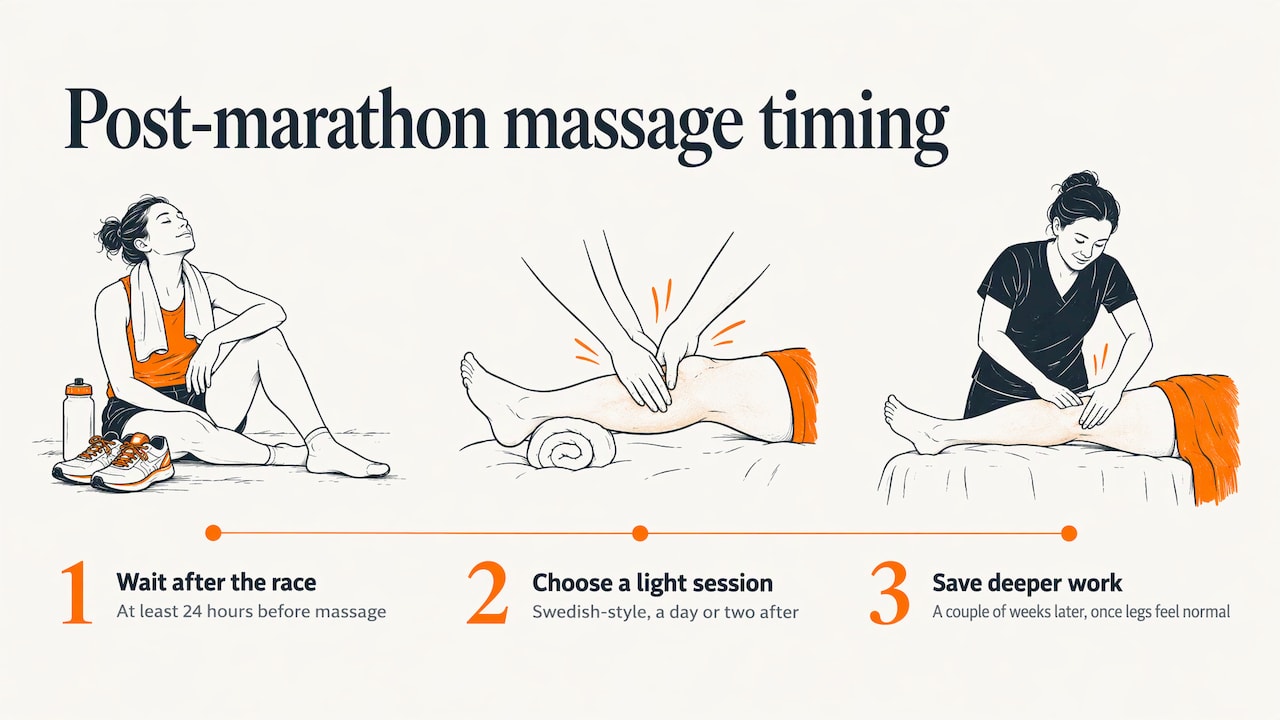
Go gentle. UCLA Health’s Dr. Duffaut says a gentle massage can help with tension and circulation after a marathon, but he advises against deep tissue work. He also notes that recovery can take days or weeks and recommends a few days off from running. Runner’s World advises waiting at least 24 hours after a marathon before getting a massage. A light Swedish-style session a day or two after the race is a reasonable plan. Save the deeper, more targeted work for a couple of weeks later, once the legs feel normal.
One more reason for care: a review cited in a 2020 article on massage and athletes noted it cannot be excluded that massaging injured tissue right after a muscle-damaging session may cause further damage. Soon after a really punishing effort, lighter is safer.
A sample schedule for marathon training
This is one way to organize it. Adjust it with your therapist and your coach.
- Base and build phase: a session every two to four weeks, sports massage or deep tissue, focused on calves, hips and glutes.
- Peak weeks: the same pattern, but book on a day after your long run, never the day before a key workout.
- Final two weeks (taper): keep pressure moderate, and make the last firm session at least a week out. Do not try anything new.
- Race week: at most a light session two to three days before the race, if you want one.
- After the race: a gentle session one to two days later. Add a deeper session once you are running again comfortably.
The pooled review we mentioned above associated 40 to 60 minutes every two weeks with the best outcomes, so if your budget and schedule allow, that is a good ceiling during heavy training blocks. Fewer sessions still help.
What a good session feels like, and what to tell your therapist
Massage should not be something you grit your teeth through. Runner’s World quotes an orthopedic massage therapist who says massage does not have to hurt to be beneficial, and that therapy happens when your body is not bracing against the therapist. If you are in serious pain mid-session, say so.
Tell your therapist:
- Your weekly mileage, your next race and its date.
- Where you feel tight, and whether it is one-sided.
- Any pain that is new, sharp or getting worse.
- How you reacted to past massage, including soreness the next day.
- What pressure feels useful, and what feels like too much.
Two-way communication is the core of how we work. Sessions stay adaptable, so pressure and focus shift as you give feedback. Runner’s World also suggests asking any therapist about their training, specialty and how often they work with runners, so ask us those questions too.
When to see a doctor before booking
Massage is not a diagnosis. If you think you have an injury, Runner’s World advises seeing a sports medicine physician before any kind of massage. The AMTA’s journal makes a related point: a massage therapist cannot diagnose, and anything new, from unfamiliar tightness to serious pain, should go to a doctor.
For runners, that means getting checked first when you have:
- Sharp or localized pain that is getting worse as you run, especially in a shin, foot or hip.
- Swelling, bruising or pain that wakes you at night.
- A sudden change in how a leg feels.
Once an injury is cleared or identified, massage can often support the rest of your plan. We have guides for common runner problems: IT band syndrome, Achilles tendonitis, knee pain and back pain. If you are unsure whether you need a clinician or a therapist, physical therapy vs. massage can help you decide.
What to do around your massage
A few simple habits make the session more useful. Most of them come from standard post-run recovery advice.
- Cool down first. University of Utah Health advises walking or light jogging for 10 to 15 minutes after hard exercise, followed by static stretches, rather than sitting down right away, as summarized in Runner’s World’s guide to what not to do after a long run.
- Refuel. That same guide says to eat within 60 minutes of finishing and to include carbohydrates, not just protein, to replenish glycogen.
- Hydrate steadily. Sip rather than chug. Mayo Clinic Health System suggests 16 to 20 ounces of fluid for every pound lost after a race, plus a recovery meal with protein soon after finishing.
- Keep moving lightly. Easy walking, an easy swim or a short spin on a bike beats sitting still all day.
In Austin, heat adds another reason to plan: summer long runs leave you dehydrated and more fatigued, so build in time to cool down and drink before you lie on the table.
Perspective: why we treat runners as a training partner
Runners tend to arrive with a story: a calf that grabs at mile eight, hips that feel locked after Sunday’s long run. What they often lack is someone who listens closely and adapts to it. That is the part of the job we care about most.
We build every session around communication. Rick Snider is a licensed therapist whose healthcare background and athletic experience shape how he reads a body and how he talks with a client. Pressure, technique and focus change as you tell us what is working. That is how a session stays effective without becoming something you have to endure.
We also think about the calendar as much as the muscles. A deep tissue session in a heavy week, a lighter one before a race and a gentle one after it are different tools for different moments. Our approach is designed to match the session to your goal, whether that is pain relief, recovery or simply feeling better on the run.
We welcome every kind of runner, from first-time 5K participants to people deep in marathon training, with clear, consent-driven practices from the first minute.
Operations
Book massage for runners in Austin
Howdy Massage offers sports massage, deep tissue, Swedish and trigger point work in Austin, in our studio or at your location with mobile sessions. Mobile can be handy after a long run, when driving across town is the last thing you want.
Published prices are $120 to $145 per session for sports massage, and $120 to $245 per session for Swedish or deep tissue. Trigger point therapy and stretching and joint mobilization have no published price, so ask us when you book. See all options on our massage services in Austin page, or start from howdymassage.com to pick a time. Tell us your mileage and your next race, and we will plan the session around it.
FAQ
Should you get a massage after a run?
Yes, in most cases. The ACSM suggests massage after a tough workout may reduce soreness and perceived fatigue, ideally for at least 20 to 30 minutes. After a marathon, choose a gentle session and wait at least 24 hours.
Is deep tissue massage good for runners?
It can be, especially for chronic tightness in the calves, glutes and hips during a training block. A 2026 review found deep tissue reduced pain more than other techniques. Avoid it right before a race and right after a marathon, and speak up if the pressure is too much.
How often should a runner get a massage?
There is no single rule. Research on massage across athletes associates sessions of 40 to 60 minutes every two weeks with the best outcomes. Many runners do every two to four weeks in heavy training, and less often otherwise. Your budget, mileage and how your legs feel matter most.
What kind of massage is best for marathon training?
Sports massage is the usual pick because it can be tailored to your training phase. Use deeper work earlier in the block, lighter work during the taper, and a gentle Swedish-style session after the race.
Sources
- Effect of sports massage on performance and recovery (Davis et al., 2020)
- Massage Alleviates Delayed Onset Muscle Soreness after Strenuous Exercise (2017)
- Mayo Clinic Press: things that may help recovery after a tough workout
- Massage therapy slightly decreased pain intensity after a 10-km run (2019)
- Randomized controlled trial of massage in ultramarathon runners (JOSPT, 2016)
- Effectiveness of Recovery Strategies After Training (2024)
- The Effectiveness of Massage Therapy in Treating Exercise-Induced Muscle Damage (2026)
- Which Type of Massage is Best for Runners?
- Sports Massage Tips (Runner’s World)
- Game Plan: Event Day Sports Massage (Massage Therapy Journal)
- The Benefits of Massages for Runners (Runner’s World)
- How to recover after running a marathon (UCLA Health)
- Post-Marathon Recovery Tips (Runner’s World)
- Does Massage Help Athletes After Exercise? (2020)
- What Not to Do After a Long Run (Runner’s World)
- Post-race recovery tips for runners (Mayo Clinic Health System)