
Massage for Sleep: What Helps, When to Book, and How
A relaxing, unhurried massage in the evening is one of the most natural ways to help your body shift toward sleep. It eases muscle tension, calms the stress response and gives you an hour where nothing is asked of you. A 2025 study found that a single 45-minute relaxation massage before bed improved sleep measures in adults with insomnia symptoms. At Howdy Massage in Austin, we offer Swedish and relaxation massage in our studio or at your location, adapted to how you feel on the table.
TL;DR
- A slow, full-body relaxation massage (Swedish style) is the most sleep-friendly choice. Deep or sports work is better saved for pain and training recovery.
- In a 2025 crossover study, a 45-minute relaxation massage before bed improved sleep efficiency in adults with insomnia symptoms.
- Book the session in the late afternoon or evening, within a couple of hours of bedtime, and keep the pressure light to moderate.
- Between sessions, gentle self-massage before bed (rocking, tapping, a massage ball on sore spots) keeps the habit going.
- Sleep trouble that keeps coming back deserves a conversation with your doctor, and massage can sit alongside that care.
Table of Contents
- Does massage help you sleep?
- Why a relaxing massage can make sleep easier
- Which massage style suits sleep best
- When to book and how often
- What to expect from a sleep-focused session
- A gentle self-massage routine for bedtime
- Safety: who should check first
- When sleep problems need a doctor
- Our view on massage and sleep
- Book a relaxing session in Austin
- FAQ
- Sources
Does massage help you sleep?
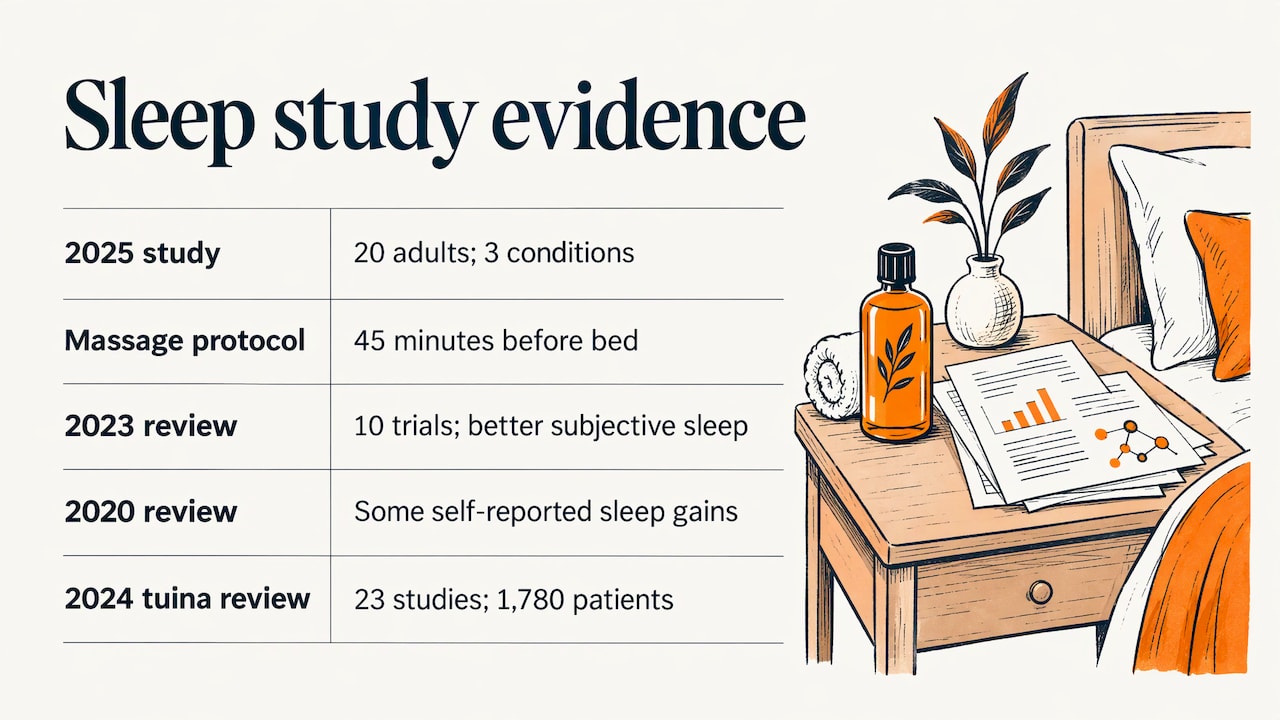
For many people, yes. The most direct evidence comes from a 2025 home-based randomized crossover study. It enrolled 20 healthy adults with Athens Insomnia Scale scores of at least 16, a threshold that points to insomnia symptoms. Each person had three conditions, one week apart: a 45-minute relaxation massage before bed, a 45-minute sham massage and no massage. The authors concluded that a relaxation massage before bedtime may be an effective and safe non-drug way to improve sleep efficiency, which is the share of time in bed you actually spend asleep.
The broader research points the same way. The American Massage Therapy Association (AMTA) summarizes that massage may support sleep by reducing pain, stress and anxiety, three of the most common reasons people lie awake. A 2023 review of ten randomized trials in hospitalized adults found significant gains in subjective sleep quality, especially with foot-reflexology massage and with massage given over two nights in cardiac-care patients. A 2020 review of cancer-survivor trials found that massage improved some self-reported sleep measures. A 2024 meta-analysis of 23 tuina studies, covering 1,780 patients, found better scores on the Pittsburgh Sleep Quality Index and the Athens Insomnia Scale than with comparison therapies.
The pattern is consistent: when the body is calmer and less sore, sleep tends to follow. That is why the type of massage and the timing matter more than any single technique.
Why a relaxing massage can make sleep easier
Three things usually keep people awake: a body that cannot settle, a mind that will not slow down, and pain that shifts every time you roll over. Massage works on all three at once.
Muscle tension. Long days at a desk, in the car or on a training schedule leave the neck, shoulders, hips and low back holding more tension than you notice. Releasing that tension changes how your body feels when you lie down.
Stress and anxiety. Slow, rhythmic touch invites the body to downshift. Many clients tell us the first sign is a deeper, slower breath partway through the session.
Pain. If a sore hip or tight upper back wakes you at 2 a.m., addressing it directly is often the fastest way to protect your sleep. This is where a therapist who listens and adjusts pressure as you go makes a real difference. If pain is the main thing waking you, our page on massage for chronic pain explains how to start.
Which massage style suits sleep best
Not every massage is a sleep massage. The AMTA notes that sleep-oriented work commonly favors gentle techniques such as effleurage, rocking and shiatsu. Effleurage is the long, gliding stroke that opens most Swedish sessions.
The 2025 study used a full-body relaxation protocol. It included work on the palms and feet, with effleurage, petrissage (kneading), tapotement (light rhythmic tapping), friction, vibration or shaking and rhythmic movement, using light-to-deep pressure over a 45-minute session. That is a recognizable Swedish-style routine: flowing, whole-body and unhurried.
Here is how our main styles compare when sleep is the goal.
| Style | Pace and pressure | Best for | Sleep fit |
|---|---|---|---|
| Swedish / relaxation | Slow, flowing, light to moderate | Winding down, stress, general tension | Best first choice |
| Deep tissue | Slower, firmer, focused on specific areas | Chronic tightness, knots, pain that wakes you | Good when pain is the sleep problem |
| Sports | Targeted, often with stretching | Training recovery | Better earlier in the day |
| Trigger point | Sustained pressure on specific knots | Headaches, referred pain | Helpful when a specific spot keeps you up |
If you are unsure how Swedish and deep tissue differ, our guide to Swedish versus deep tissue massage walks through the choice. You can also read what a Swedish massage involves before you book.
When pain is the sleep thief
If you fall asleep fine but wake with a stiff neck, an aching low back or a pulsing headache, a relaxation massage alone may not be the whole answer. In that case we often combine broad, calming strokes with focused work on the area that bothers you, using deep tissue or trigger point massage. If tension headaches are the issue, see our page on headache relief in Austin.
When to book and how often
Timing is part of the technique. The AMTA reports that studies typically give massage within one to two hours before bedtime, as long as the session is not too stimulating. For most people that means a late-afternoon or early-evening appointment, followed by a quiet night.
A few practical choices make the session work harder for your sleep:
- Pick the last slot you can comfortably attend. The closer to bedtime, the less time you spend rushing back into your day.
- Ask for light to moderate pressure and a slower pace. Tell your therapist the goal is sleep, not fixing a knot. That one sentence changes the whole session.
- Keep the evening simple afterward. Skip the heavy meal, the hard workout and the late screen time. Drink some water and head home.
- Consider a mobile session. If the drive home is the part that undoes the calm, we can come to you, so you can go straight from the table to bed.
On frequency, there is no single prescription. The 2020 cancer-survivor review associated a cumulative dose of roughly 90 to 120 minutes of massage, spread over three days or several weeks, with some sleep benefits. In practice, that supports a regular rhythm rather than a one-off treat: many people find that a recurring appointment, paired with a short nightly routine, is easier to stick with and easier to notice results from.
What to expect from a sleep-focused session
At Howdy Massage, sessions are built around communication. Before we start, we ask what is keeping you up: racing thoughts, a sore back, restless legs, or simply a body that will not switch off. During the session we check in on pressure and adjust, so you are never guessing whether to speak up. You can see the services we offer, and our published price ranges, on our massage services page.
The goal is a session where you can let go. Dim lighting, a comfortable temperature and a steady rhythm all help, and a therapist who is paying attention to your cues means you do not have to manage the experience yourself. For many clients, the most useful feedback is simple: tell us if you drifted off. That tells us the pacing worked.
If you take a mixed approach, for example a relaxation massage most weeks and a firmer session when your shoulders are especially tight, that is fine. We tailor each visit to how your body feels that day.
A gentle self-massage routine for bedtime
Professional sessions are the anchor; a few minutes at home helps carry the effect between visits. The AMTA suggests gentle rocking while sitting at the side of the bed, or tapping, and says a massage ball or cane may ease muscle pain before bed. Here is a simple version:
- Sit on the edge of the bed and rock gently forward and back for a minute, breathing slowly.
- Tap lightly with your fingertips along the shoulders and the sides of the neck.
- Roll a massage ball under the sole of each foot or against a tight spot in the upper back, using comfortable pressure only.
- Finish with slow strokes down the forearms and over the hands, then lie down.
Keep the pressure gentle. Vigorous work is stimulating, which is the opposite of what you want at night. The routine fits well inside a broader after-work wind-down routine: dim the lights, put the phone away and give your body a consistent cue that the day is over.
Safety: who should check first
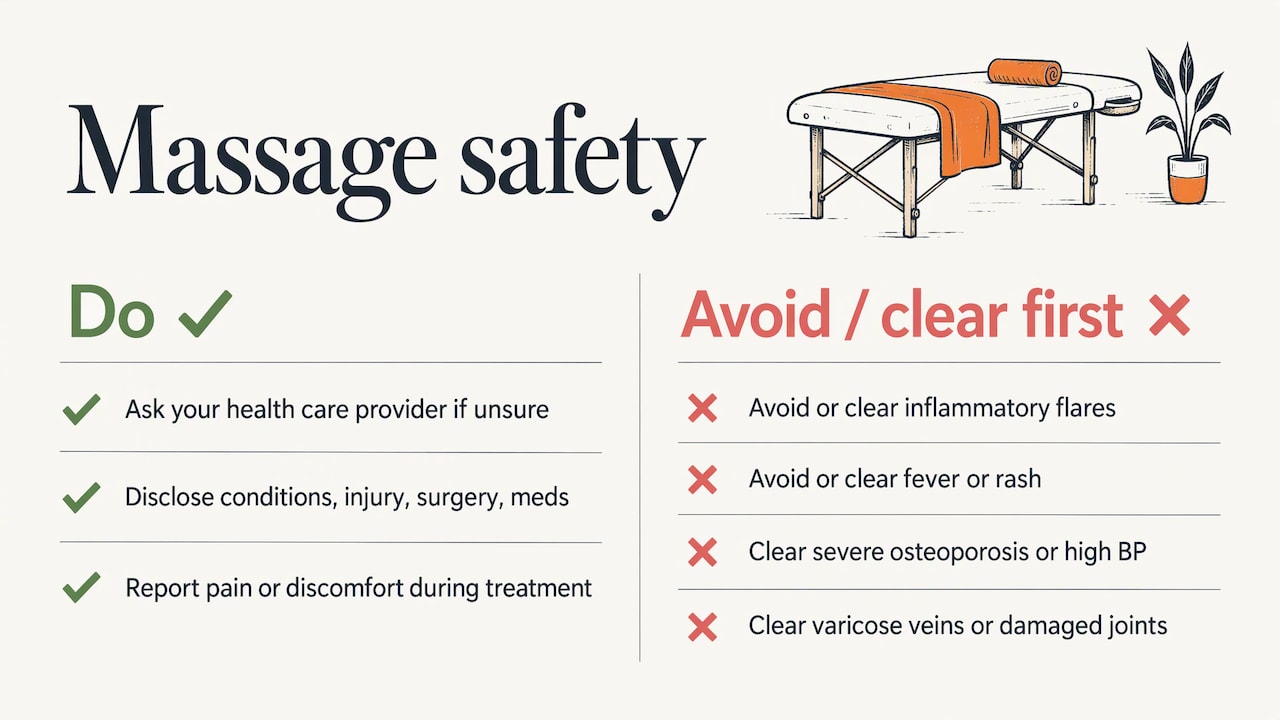
Massage is low-risk for most people. The National Center for Complementary and Integrative Health (NCCIH) says the risk of harm appears low overall, though rare serious events such as blood clots, nerve injury and bone fracture have been reported, particularly with vigorous massage or in people at increased injury risk, such as older adults. If you are unsure whether massage is right for you, ask your health care provider first.
The Arthritis Foundation advises avoiding massage or getting medical clearance during an inflammatory flare, with a fever or rash, with severe osteoporosis, high blood pressure or varicose veins, or when joints are damaged. It also says to report any pain or discomfort during treatment.
Tell your therapist before the session about any medical condition, recent injury, surgery or medication, and about anything that hurts during the session. We can lighten the pressure or change the approach right away. For older adults, our page on massage and healthy aging covers how sessions are adapted.
When sleep problems need a doctor
Massage can support a better night, but it does not replace medical evaluation. The AMTA states that persistent sleep problems warrant professional evaluation by a doctor. See your doctor if you have trouble sleeping most nights for weeks, if you snore loudly or stop breathing in your sleep, if you feel unrefreshed despite enough hours, or if daytime sleepiness affects your driving or work.
For chronic insomnia specifically, the American Academy of Sleep Medicine’s 2021 guideline strongly recommends multicomponent cognitive behavioral therapy for insomnia (CBT-I), a structured program run by a trained clinician. A doctor can help you decide on that care, and a regular massage fits alongside it as a way to reduce the physical tension and stress that make nights harder.
Our view on massage and sleep
We see sleep as a body problem and a mind problem at the same time, and a massage session is one of the few places where you can address both in the same hour.
Our approach is built on communication. Many people arrive with their shoulders up around their ears and no idea how to let go. A session where the therapist checks in about pressure, pace and comfort teaches the body that it is safe to relax, and that matters as much as any single stroke.
Rick Snider, our licensed therapist, brings a healthcare background and his own athletic experience to every session. That combination helps him tell the difference between a client who needs slow, flowing relaxation work and one whose pain is the real reason they are awake at night, and to adjust within the same appointment.
That is why we do not offer one script. A Swedish or relaxation session suits the person who needs to wind down. Deep tissue or trigger point work suits the person whose neck or back keeps waking them. Sessions are adaptable, in our studio or at your location, and shaped around your comfort and goals.
Operations
Book a relaxing session in Austin
If you want massage to help you sleep, start with a Swedish or relaxation session in the late afternoon or evening and tell us sleep is the goal. Swedish and deep tissue sessions at Howdy Massage are published at $120 to $245, and we come to your location if you prefer to go straight to bed afterward. See the Swedish massage in Austin page or our full massage services to choose your session.

If an ache, a tight neck or a nagging knot is what keeps you up, tell us that too. We can build the session around it.
FAQ
Does massage help with insomnia?
Massage may support sleep by easing pain, stress and anxiety, which are common reasons people sleep badly. In a 2025 crossover study of adults with insomnia symptoms, a 45-minute relaxation massage before bed improved sleep efficiency. If your sleep problems are persistent, see your doctor, and keep massage as part of your wind-down.
What kind of massage is best for sleep?
A slow, full-body Swedish or relaxation massage with light to moderate pressure is the usual choice. Professional guidance points to gentle techniques such as effleurage and rocking for sleep. If pain is what wakes you, deep tissue or trigger point work on the sore area can be added.
How close to bedtime should I get a massage?
Studies typically give massage within one to two hours before bed, as long as it is not too stimulating. A late-afternoon or early-evening appointment works well for most people. A mobile session lets you go straight from the table to bed.
Can I give myself a massage before bed?
Yes, keep it gentle. Rocking while seated on the edge of the bed, light tapping, and a massage ball on sore spots are all suggested for pre-bed use. Avoid vigorous pressure, and check with your health care provider if you have a condition such as osteoporosis, high blood pressure or varicose veins.
Sources
- The Impact of Relaxation Massage Prior to Bedtime on Sleep (2025)
- Massage Effects on Sleep, Massage Therapy Journal (AMTA)
- Effect of massage therapy on sleep quality in critically ill adults (2023)
- Randomized control trial evidence for the benefits of massage in cancer survivors (2020)
- Effect of tuina on sleep quality, psychological state and more (2024)
- Massage Therapy: What You Need To Know, NCCIH
- Benefits of Massage, Arthritis Foundation
- Behavioral and psychological treatments for chronic insomnia, AASM (2021)
- How to Relax After Work: A Wind-Down Routine