
Patellar Tendonitis Massage: What Helps and What to Skip
Massage can be a useful part of managing patellar tendonitis (jumper’s knee), as long as it sits alongside progressive strengthening and not in place of it. The best-supported approach is to work the quadriceps and surrounding muscles, use light to moderate pressure on the tendon only when it is calm, and keep loading the tendon gradually. Below: what the research says, what a session looks like, what you can do at home, and when to stop and get the knee examined.
TL;DR
- A 2024 systematic review found that manual techniques, including transverse friction massage, combined with exercise looked effective for patellar tendinopathy. Massage alone has not been tested in isolation.
- Most massage for jumper’s knee targets the quadriceps and nearby muscles. Work on the tendon itself is gentle, and only when it is not flared up.
- Strengthening and load management are the foundation of recovery. Massage is a support for that work, not a substitute.
- Stop and see a physician or physical therapist for swelling, warmth, instability, trouble bending or straightening the knee, or pain that keeps getting worse.
- In Austin, we offer sports, deep tissue and trigger point massage in our studio or at your location.
Table of Contents
- What patellar tendonitis is, and why people reach for massage
- Does massage help jumper’s knee? What the research shows
- Where massage fits: quadriceps first, tendon second
- Massage for patellar tendonitis at home
- When to wait, and when to get checked
- Massage works best with progressive loading
- How long does recovery take?
- Our perspective on massage for jumper’s knee
- Book a session in Austin
- FAQ
- Sources
What patellar tendonitis is, and why people reach for massage
The patellar tendon connects the bottom of your kneecap to the top of your shinbone. Jumping, sprinting, cycling hills, squatting and lunging all load it, and when it is overloaded, you feel pain at the front of the knee, usually just below the kneecap. Many clinicians now prefer the term patellar tendinopathy because the problem is often more about tendon load tolerance than simple inflammation, but most people search for tendonitis, jumper’s knee or patellar tendon pain, and they mean the same area.
People turn to massage for a few reasons. The quadriceps and hip muscles feeding into the tendon are often tight and sore. Massage feels good and can ease pain in the short term. And it is a low-risk thing to do while the tendon is being rebuilt. The honest question is how much it contributes, and the research gives a clear enough answer.
Does massage help jumper’s knee? What the research shows
The strongest recent evidence is a 2024 systematic review and meta-analysis of six studies (309 participants aged 16 to 40). It found that combining manual techniques, including transverse friction massage, with a squat on an inclined plane appeared effective for patellar tendinopathy. The experimental groups improved by a mean of 60% on the VISA-P scale (a questionnaire that scores symptoms and function) and had a mean 2-point drop in pain on a 10-point scale.
That result is about a package: soft-tissue work plus an exercise program. A 2012 systematic review of deep friction massage noted that the studies varied too much to draw one unified conclusion and that friction massage as a single treatment had not been compared on its own against other methods. The same authors pointed out that adding load to the tendon and reducing molecular cross-linking during healing through transverse massage is a plausible explanation for the responses people report.
A 2022 review of conservative treatments noted that deep friction massage may reduce pain immediately, and that fascial manipulation of the quadriceps had similar effects. It also noted there is no consensus on the single best method or rehab protocol.
What that means for you in practical terms:
- Massage is reasonable to include, especially as a way to calm pain so you can train.
- The best results in the research come when massage is paired with exercise.
- Short-term pain relief is the most realistic expectation. It is not a replacement for rebuilding the tendon’s capacity.
Does pressure need to be deep?
Not necessarily. A 2020 study discussed by Penny Goldberg, DPT, ATC, in Massage & Fitness Magazine found that the immediate pain reduction from massage was not related to how much pressure the therapist used. For a sensitive knee, that is good news: a session can be adjusted to what your body tolerates and still be worthwhile. It is also why we check in with you throughout, rather than pushing to a fixed depth.
Where massage fits: quadriceps first, tendon second
A common mistake is to grind directly on the sore spot below the kneecap. Most of the useful work happens above it. The quadriceps, hip flexors, hamstrings, calves and glutes all influence how much load reaches the tendon. Goldberg notes that the knee does not work in isolation, and that the soft tissue of the hip, low back, foot and ankle may need attention as well. We treat the person, not just the sore spot.
Quadriceps tendon vs. patellar tendon
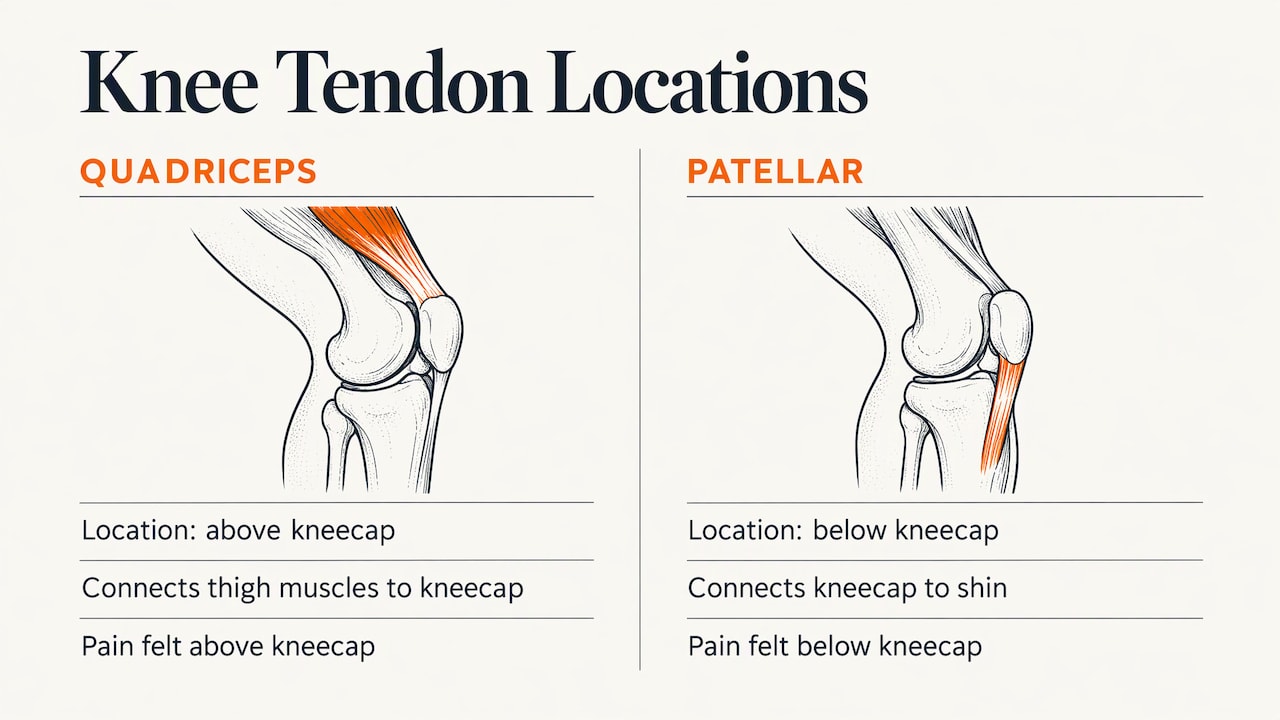
The quadriceps tendon sits above the kneecap and joins the thigh muscles to it. The patellar tendon sits below it and joins the kneecap to the shin. Pain above the kneecap points to the quadriceps tendon, and pain below points to the patellar tendon. Both belong to the same knee extensor system and respond to the same principles: manage load, rebuild strength, and keep the surrounding muscles from adding extra tension.
What a session can include
In a typical session for front-of-knee pain, the work may include:
- Long, broad strokes on the quadriceps, from the hip crease down to a few inches above the kneecap, to reduce overall tension in the muscle group.
- Trigger point work in the quads, hip flexors, glutes and calves if those areas are tender or referring pain. See our page on trigger point massage.
- Lateral thigh and IT band area work, since tight tissue there can pull on the kneecap’s tracking. We cover this in massage for IT band syndrome.
- Light, controlled work on the patellar tendon when it is calm, which may include gentle cross-friction across the fibers or an active technique where you move your knee while the therapist applies light pressure.
- Stretching and joint mobilization for the hips, ankles and knee if you are stiff.
One technique described in the Massage & Fitness Magazine article is an active stretch or pump massage. You sit with your legs dangling over the edge of the table, and the therapist applies pressure at the bottom edge of the kneecap while gently moving your lower leg from straight to bent. It may reduce quadriceps tension by engaging the hamstrings. It is a good example of why communication matters during the session: you can tell us right away if the tendon objects.
Massage for patellar tendonitis at home
Self-care can fill the gaps between sessions. Keep it gentle and short.
Quadriceps rolling. A physical therapist at On The Move Physical Therapy recommends rolling the quads from the hip crease to just above the knee, without rolling over the kneecap itself. Roll slowly and pause on tender spots rather than rushing.
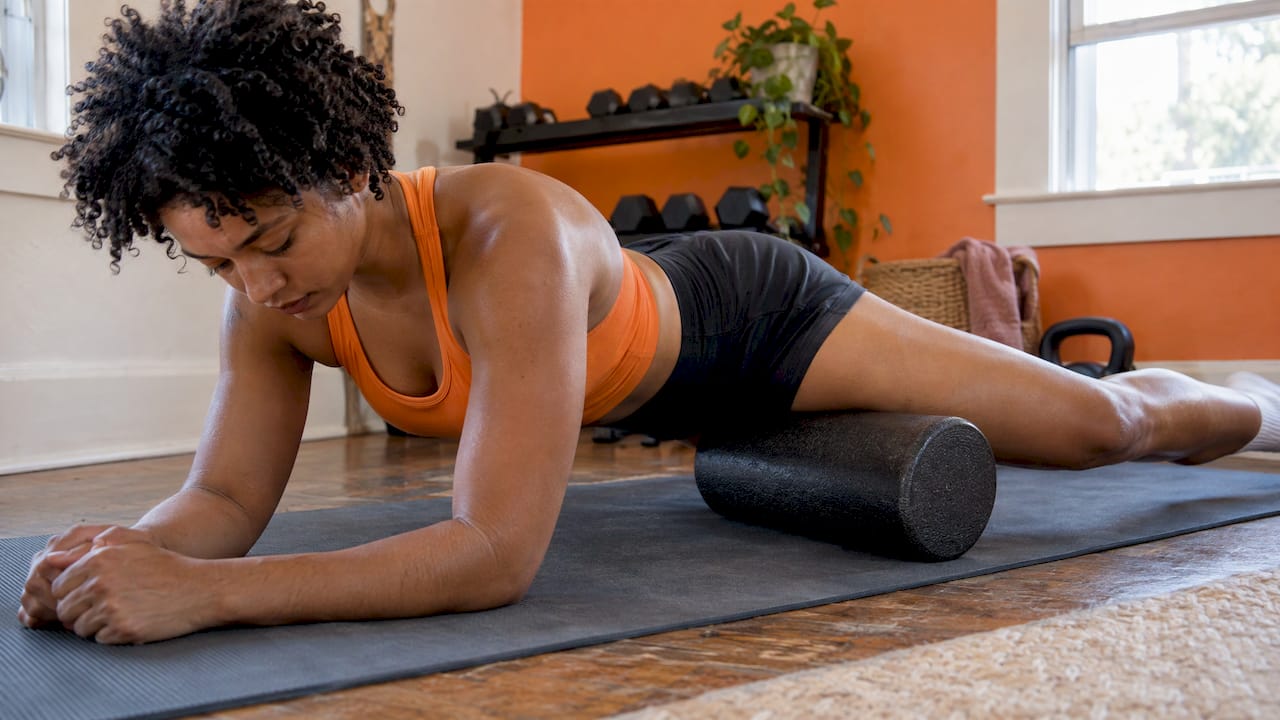
Gentle tendon massage. The same source suggests massaging the patellar tendon both up and down and side to side. Use a little lotion or oil, a fingertip or two, and light to moderate pressure. It should feel like pressure, not sharp pain.
Keep it brief. A couple of minutes on each area is plenty. More pressure and more time do not mean better results, particularly given that pain relief was not tied to pressure in the study above.
Do not substitute it for your exercises. If you have a rehab program, do that first. Massage is the supporting act.
When to wait, and when to get checked
Timing matters more than technique here.
- During a flare-up, leave the tendon alone. If the knee is swollen, warm, or the pain has recently intensified, avoid pressing directly on the tendon and wait until it settles. You can still work gently on the thigh muscles above the knee if that feels comfortable.
- Do not push through pain. Mayo Clinic advises seeing a healthcare professional if pain during or after activity does not improve with ice or rest, and notes that working through pain can cause more damage to the tendon.
- Know the red flags. Mayo Clinic’s knee pain guidance says to call a doctor if you cannot bear weight on the knee, it feels unstable or gives out, it is markedly swollen, you cannot fully straighten or bend it, you see an obvious deformity, you have a fever along with redness, pain and swelling, or the pain is severe after an injury.
If you are not sure whether your pain is the tendon, the kneecap joint or something else, our guide to massage for knee pain explains how to tell where massage helps and when to stop.
Massage works best with progressive loading
The research on rehabilitation is consistent: the tendon needs load to recover. A 2021 clinical review in PMC states that rest and passive modalities are inferior to exercise and progressive loading for symptoms and function. It describes reducing tendon stress at first, then increasing load step by step, alongside quadriceps strengthening and tendon-loading exercise.
A 2021 systematic review of management found that eccentric loading, with or without added treatments, should remain a first-line option. It also found that isometric exercise appeared as effective as isotonic exercise for immediate pain relief, though the strength of evidence was low. The 2022 ACSM Current Sports Medicine Reports article on knee extensor tendinopathy likewise points to structured rehabilitation with eccentric or heavy slow resistance exercise and load management.
This is where massage earns its place. If it lowers soreness and tension enough that you can do your isometrics, slow squats or decline work more comfortably, it is doing its job.
A simple weekly rhythm
This is an illustration, not a prescription. Your rehab plan should come from your physical therapist or physician.
| Day | Focus | Where massage fits |
|---|---|---|
| Training or loading days | Prescribed strengthening, activity within tolerance | Brief quad rolling afterward if the thighs feel tight |
| Lighter days | Mobility, gentle movement | Self-massage of quads and calves |
| Once every week or two | Professional session | Broader work on quads, hips, glutes and calves, plus light tendon work if calm |
For more on how the two professions divide the work, see physical therapy vs. massage.
Other things people pair with massage
Mayo Clinic lists physical therapy techniques for patellar tendinitis that include quadriceps stretching, gradual strengthening, strapping or taping to take pressure off the tendon, and iontophoresis. Some people also explore options like red light therapy for knee pain as part of their recovery routine. Whatever you add, run it by your clinician so it fits your plan.
How long does recovery take?
Patience is part of the treatment. A 2016 systematic review of causes and rehabilitation found that proposed rehabilitation periods ranged from 6 to 12 weeks, and that a longer period may be appropriate because the patellar tendon recovers slowly. An American Family Physician article notes that treatment is generally conservative and that surgery may be considered if symptoms do not improve after three months, which applies to up to 10% of patients.
If you are three months in and not improving, that is a conversation for your physician, not a reason to add more pressure on the tendon.
Our perspective on massage for jumper’s knee
We see jumper’s knee most often in people who love to move: runners, cyclists, lifters, basketball and volleyball players, and weekend athletes who ramped up too quickly. They usually arrive having tried one of two things: pushing through the pain, or resting completely. Neither tends to solve it.
Our approach is to make the rest of the leg work better so the tendon has an easier job. That means thorough work on the quads, hip flexors, glutes and calves, and a careful, communicative approach to the tendon itself. Rick Snider, our licensed therapist, draws on his healthcare background and his own athletic experience, and he adjusts pressure and technique throughout the session based on what you tell him.
We want you to leave a session moving more freely and feeling ready to do your strengthening work, not sorer or more guarded. Deep tissue, sports and trigger point work can all play a role, and we choose among them based on how your knee is behaving that week. When something calls for a physical therapist or physician, we say so.
Operations
Book a session in Austin
If front-of-knee pain is limiting your training or your day, we can build a session around your quads, hips and the way you move. We offer sports massage and deep tissue massage in our Austin studio or at your location. Our published prices are $120 to $245 for deep tissue and $120 to $145 for sports massage. See the full list of services for details and booking.

Tell us at the start where the pain sits, what aggravates it and what your rehab looks like. Cyclists can also read our notes on massage for cyclists, and if your pain travels toward the ankle, our guide to Achilles tendonitis massage covers a related tendon.
FAQ
Is it OK to massage a patellar tendon that hurts?
Yes, gently, when the knee is calm. Use light to moderate pressure and stop if the pain sharpens. If the tendon is swollen, warm or newly worse, wait until it settles and focus on the thigh muscles above the knee instead.
Does massage help patellar tendonitis on its own?
Research supports manual techniques combined with exercise, but massage alone has not been tested head to head. Think of it as a way to ease tension and pain while you rebuild the tendon with progressive strengthening.
What muscles should be massaged for jumper’s knee?
The quadriceps are the main target, along with the hip flexors, glutes, hamstrings, IT band area and calves. Those muscles affect how much stress reaches the tendon. A therapist can also check the hip, ankle and foot, since the knee works as part of a chain.
How is quadriceps tendon pain different from patellar tendon pain?
The quadriceps tendon is above the kneecap and the patellar tendon is below it. Pain location tells you which is involved. Both respond to load management, strengthening and work on the thigh muscles, but a clinician should confirm which is irritated.
When should I see a doctor instead of booking a massage?
See a physician or physical therapist if the knee is swollen, unstable, locks or cannot fully bend or straighten, if you have a fever with a red, painful knee, or if pain keeps worsening despite rest. Pain that has not improved after several weeks of sensible care also deserves an evaluation.
Sources
- The Effects of Soft-Tissue Techniques and Exercise in the Treatment of Patellar Tendinopathy (2024)
- Deep friction massage to treat tendinopathy: a systematic review (2012)
- Conservative Treatments for Patellar Tendinopathy: A Review (2022)
- Does massage work for jumper’s knee? Massage & Fitness Magazine
- The Patellar Tendon, On The Move Physical Therapy
- Patellar tendinitis: Diagnosis and treatment, Mayo Clinic
- Knee pain: Symptoms and causes, Mayo Clinic
- Clinical Management of Patellar Tendinopathy (2021)
- Management of patellar tendinopathy: a systematic review (2021)
- Knee Extensor Mechanism Tendinopathy, ACSM Current Sports Medicine Reports (2022)
- Common Running Injuries: Evaluation and Management, American Family Physician (2018)
- Causative factors and rehabilitation of patellar tendinopathy (2016)