
Psoas Release Massage: What It Is and What to Expect
Psoas release massage is slow, specific pressure through the lower abdomen and the front of the hip, aimed at the deep hip flexor that connects your lower spine to your thigh. Done well, it works with your breathing and your feedback rather than against them, and it is usually combined with work on the hip flexors, low back and glutes around it. If tight hips, a achy low back or a pinching feeling at the front of the hip keep coming back, a licensed therapist who communicates throughout the session is the right person to reach this muscle. At Howdy Massage in Austin, Rick Snider builds each session around your comfort level and your goal, in the studio or at your location.
TL;DR
- The psoas is a deep hip flexor that runs from the lower spine to the top of the thigh bone, so it is reached through the abdomen and the front of the hip, not from the back.
- Research on psoas-focused work is early but encouraging: in one 2025 trial it improved low back disability scores when added to physiotherapy, and massage techniques in general reduced pain and disability in people with low back pain.
- A session should feel like firm, slow pressure you can breathe through. You set the limit, and you should be able to tell your therapist to back off at any moment.
- Abdominal pain with fever, a pulsing sensation, numbness, leg weakness, or pain after a fall needs a medical evaluation before any massage.
- Psoas work fits inside a deep tissue, sports or trigger point session in Austin, and pairs well with work on the hips and low back.
Table of Contents
- What the psoas is and why it gets tight
- What psoas release massage actually involves
- What the research says
- What it feels like and what to expect afterward
- Safety: who should check with a doctor first
- Is psoas release right for your pain?
- Book psoas work in Austin
- Our view on the psoas
- FAQ
- Sources
What the psoas is and why it gets tight
The psoas major starts on the sides of the lower spine (the lumbar vertebrae and the lowest thoracic one), runs through the pelvis, and attaches near the top of the thigh bone. Its main jobs are flexing the hip, rotating the thigh outward and supporting posture, both when you move and when you stand still.
That description explains most of the complaints people bring us:
- Long sitting. Desk work holds the hip in a bent position for hours. Many people feel it as stiffness when they stand up, or a pull at the front of the hip.
- Running, cycling and lifting. Every stride or pedal stroke uses the hip flexors. Cyclists in particular spend long hours folded forward. Our guide to massage for cyclists covers how that load builds up.
- Low back tension. Because the muscle attaches to the lumbar spine, tightness there can show up as a low back ache that does not match what you feel when someone rubs your back.
Not every ache in these areas comes from the psoas. The hip flexors, the quadratus lumborum, the glutes and the joint itself can all produce similar pain. Part of a therapist’s job is working out which one it is, and that is why a conversation and a quick assessment come before any deep pressure. If your pain sits more toward the side of the low back, our page on QL release massage describes that neighbor.
What psoas release massage actually involves
The psoas lies behind the abdominal contents, so there are two ways to reach it by hand.
Through the abdomen. With you lying on your back, knees bent, the therapist settles in slowly beside the navel and works gradually deeper over many breaths. Slow is the whole technique: rushing makes the abdominal wall tighten and push the hand out. You may feel a dull, deep pressure and sometimes a referral into the groin or low back. It should never be sharp, and it should ease as you exhale.
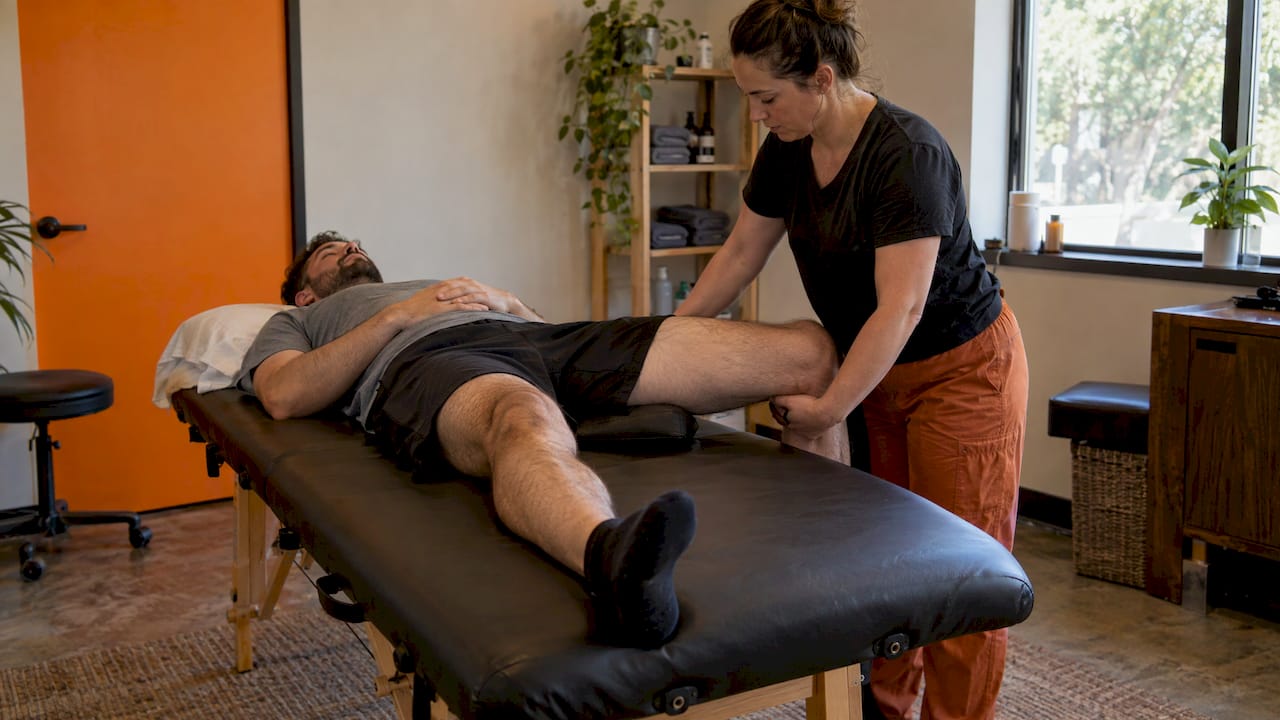
At the front of the hip. Where the muscle crosses the pelvis and heads for the thigh bone, it can be addressed with the hip flexors around it. This is often more comfortable for people who are sensitive in the belly, and it is useful for runners and cyclists whose tightness concentrates at the hip.
Most sessions also include some of the following:
- Work on the surrounding hip flexors, quadriceps and glutes.
- Gentle movement, such as slowly sliding a heel or shifting the pelvis, while pressure is held.
- Stretching and joint mobilization once the tissue has softened, which we offer alongside massage.
Psoas trigger point massage
Trigger points are tight, band-like knots in a muscle that can cause pain, sometimes felt away from the spot itself. A 2023 review in American Family Physician notes that clinical trial evidence supports massage, physical therapy and manual medicine as first-line, less invasive treatments. In massage, direct pressure is applied slowly and in a controlled way over the point. Psoas trigger point work follows the same logic, just deeper and more patient. You can read more about the method on our trigger point massage page.
Where myofascial release fits
Myofascial release uses sustained, gentle pressure and stretch on the connective tissue around muscle. It is a natural fit for the psoas because the goal is a slow melt, not a forceful push. How it feels and when it helps is explained on its own page.
What the research says
The research on psoas work specifically is small, so it helps to read it for what it is.
- Psoas myofascial release plus physiotherapy. A randomized trial of 40 people with nonspecific chronic low back pain added four sessions of psoas myofascial release, each technique held for 3 to 5 minutes, to eight sessions of physiotherapy. The group that received it showed a significant drop in the Roland Morris disability index, a questionnaire about how much back pain limits daily activity.
- Massage techniques for low back pain. A 2025 randomized trial of 110 adults with subacute or chronic low back pain compared classical massage, myofascial release and trigger point therapy. All three reduced pain and disability at six weeks compared with controls. Myofascial release gave the largest functional improvement and the highest satisfaction, results held at three and six months, and no serious adverse events were reported.
- Hip flexor counterstrain. A trial registered at ClinicalTrials.gov tested a gentle positioning technique for the iliopsoas in 32 people with mechanical chronic low back pain, a sign that researchers are actively studying this muscle.
The practical reading: hands-on work around the psoas and low back is a reasonable part of a plan for back and hip pain, and results tend to be best when it is combined with movement and exercise. The AFP authors make the same point for myofascial pain in general, describing trigger point treatment as one piece of a multimodal, team-based approach. That matches how we work: massage, stretching and mobility together, tuned to what your body responds to.
What it feels like and what to expect afterward
Expect deep, slow pressure that you can breathe into. Many people describe a heavy, “good hurt” sensation, then a softening as the muscle lets go. Some feel a warm, loose sensation at the front of the hip, or an easier, longer stride in the days after.
A few ground rules make the session work:
- Tell your therapist what you feel. Pressure should sit at a level where your breathing stays slow. If you are holding your breath, the pressure is too much.
- Slower beats deeper. The muscle is protected by layers of tissue and your own reflexes. Gradual pressure gets further than force.
- Expect some tenderness. Mild soreness for a day or so can follow deep work, much like after a hard workout. Drink water and move gently.
How many sessions you need depends on how long the tightness has been there and what keeps feeding it. A desk worker with years of sitting usually needs a different plan than a runner with a tight hip flexor after a big training block. We talk it through at your first visit rather than promising a number up front.
Safety: who should check with a doctor first
The National Center for Complementary and Integrative Health says the risk of harmful effects from massage therapy appears low, but rare serious problems such as blood clots, nerve injury and bone fracture have been reported, more often with vigorous styles like deep tissue massage or in higher-risk people such as the elderly.
Because psoas work goes deep into the abdomen and pelvis, we ask you to see a doctor before booking if any of these apply:
- Abdominal or groin pain with fever, nausea, or a pulsing or throbbing feeling in the belly.
- Numbness, tingling or weakness spreading into the leg, or any change in bladder or bowel control.
- Hip or back pain after a fall or accident.
- A history of blood clots, a bleeding disorder or blood thinners, a recent abdominal surgery, an abdominal aortic aneurysm, or pregnancy.
- Pain that is constant, wakes you at night or keeps getting worse.
Tell your therapist about any of these, along with other conditions or medications, at the start of your visit. Consent and communication are part of every session with us: you can ask for lighter pressure or stop at any time.
Is psoas release right for your pain?
| What you notice | Where it usually points | What we would look at |
|---|---|---|
| Stiff, pulling front of the hip after sitting | Hip flexors, including the psoas | Hip flexor and psoas work, stretching |
| Low back ache that eases when you lie with knees bent | Lower back and psoas | Psoas, glutes and low back together |
| Tightness on the side of the low back | Quadratus lumborum | QL work |
| Hip pain that is deep in the joint or catches | Several possible sources | A conversation first; see our hip pain guide |
| Pain that has lasted months | Often a mix of muscles and habits | A plan; see our chronic pain guide |
If you want to compare massage with other options for a back or hip problem, physical therapy vs. massage lays out which fits which problem. For a wider look at the lower back, see massage for back pain.
Book psoas work in Austin
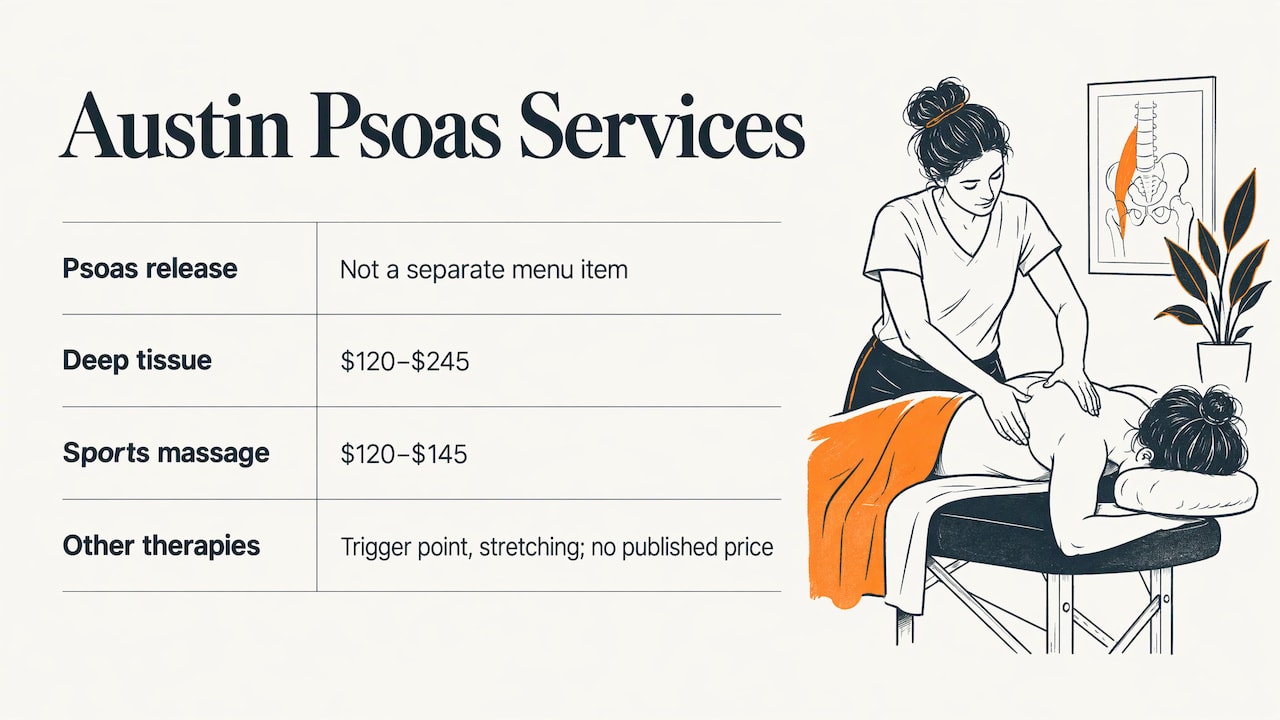
Psoas release is not a separate menu item for us. It is part of how we approach deep tissue, sports and trigger point work for the hips and low back. Deep tissue massage is published at $120-$245 and sports massage at $120-$145, in the studio or at your location. Trigger point therapy and stretching and joint mobilization are also offered, with no published price on our site.
Tell us at booking that the hips or psoas are your focus, and Rick will plan the session around it. You can see every service and book on our massage services page.

If you train, our sports massage in Austin page explains how sessions fit around training blocks. For a firmer session aimed at chronic tightness, see deep tissue massage in Austin.
Our view on the psoas
Few muscles collect as many promises as the psoas. We prefer a plain approach: it is a real muscle that gets overworked by sitting, running and lifting, and it responds to patient, well-communicated hands-on work.
What matters most to us is that you stay in control. Deep work on the abdomen and hip only helps when you can breathe through it and tell us what you feel, so we check in constantly and adapt pressure and technique to your comfort level. Our therapist’s healthcare background and athletic experience shape how we read what a tight hip is telling us.
We also look past a single muscle. The hip, low back and glutes work as a unit, so we combine massage with stretching and joint mobilization and set goals with you: easier mornings, a longer run, a day at the desk without the ache.
Operations
FAQ
Can a massage therapist release the psoas?
Yes. A licensed therapist can reach the psoas through the lower abdomen with slow, progressive pressure, and can work the part of the muscle at the front of the hip. The key is pacing and communication, so the muscle relaxes instead of guarding.
How long does psoas release take?
It is usually one part of a full session, not the whole thing, since the surrounding hip flexors, low back and glutes get attention too. The pressure is built up gradually over several slow breaths, so it is not a quick poke. How many visits you need depends on how long the tightness has been there.
Does psoas release hurt?
It can feel deep and tender, but it should not be sharp, and you should be able to keep breathing slowly. Pressure that makes you hold your breath is too much, so say so. Mild soreness for a day afterward is common with deep work.
What is the difference between psoas release and psoas trigger point massage?
Psoas release is the broader goal of softening the muscle and its surroundings, often with myofascial techniques. Trigger point massage targets a specific tender knot with sustained, controlled pressure. In practice a session can use both.
Sources
- Anatomy, Bony Pelvis and Lower Limb: Psoas Major, StatPearls
- Trigger Point Management, American Family Physician (2023)
- Trigger Point Management, American Family Physician (2023), full text PDF
- Effect of Psoas Muscle Myofascial Release on Pain and Disability, PMC
- The effectiveness of different massage techniques in low back pain, 2025 trial
- Iliopsoas Counterstrain and Mechanical Chronic Low Back Pain, ClinicalTrials.gov
- Massage Therapy: What You Need To Know, NCCIH