
Shoulder Blade Pain Massage: What Helps and What to Know
Massage can ease shoulder blade pain when the cause is muscular: held tension, overuse, or tight muscles in the chest, neck and upper back pulling on the scapula. The most useful session is rarely a rub on the sore spot alone. It starts with finding which muscles are actually driving the pain, then works those. At Howdy Massage in Austin, deep tissue, trigger point and myofascial work are built around that kind of conversation, adjusted to what you can comfortably tolerate.
TL;DR
- Pain around the shoulder blade usually comes from tight muscles in the upper back, chest and neck, from repetitive motion or from long hours at a desk.
- A 2017 meta-analysis of 15 studies found massage significantly reduced shoulder pain in both the short and long term.
- The best results come from treating the whole area: the muscles under the blade, the chest in front and the thoracic spine, not just the sore point.
- See a doctor first for sudden numbness, weakness, severe swelling, pain after an accident, or pain that keeps getting worse.
- Tell your therapist about the pain level throughout a session. Pressure should feel productive, not like something you have to endure.
Table of Contents
- What is going on under your shoulder blade
- Can massage help shoulder blade pain?
- What a therapist actually works on
- Shoulder impingement: where massage fits
- What a session feels like, and how to make it work
- When to see a doctor first
- Between sessions: sleep and heat
- Who gets the most from this
- Our perspective
- Book a session in Austin
- FAQ
- Sources
What is going on under your shoulder blade
The shoulder blade, or scapula, is a flat bone that floats on the back of your rib cage. It has no direct bony attachment to your trunk. Muscles hold it in place and move it: the rhomboids and trapezius between the blade and the spine, the levator scapulae running up to the neck, the rotator cuff muscles that cover the blade itself, and the pectoralis minor in front.
When some of these muscles stay tight and others get overstretched, the blade stops gliding smoothly and the area aches or burns. Pain specialists writing in the AMTA’s Massage Therapy Journal describe shoulder pain as usually a puzzle with several pieces: held tension, repetitive motion, or strain from imbalance in the muscles that move the upper arm. They also note that tight scalene or pectoralis minor muscles can compress nerves of the brachial plexus, the network running from the neck into the arm.
Common triggers include:
- Desk work with the head forward and shoulders rounded
- Overuse from lifting, swimming, climbing, racket sports or repetitive overhead work
- Old injuries, post-surgical tightness and adhesions around the shoulder capsule and collarbone
- Heavy training days with little recovery
- Sleeping on the same side every night
That is why the pain you feel between your shoulder blades often has its source somewhere else. A tight chest can pull the blades forward and keep the upper back muscles stretched and sore.
Can massage help shoulder blade pain?
The evidence is encouraging. A 2017 meta-analysis pooling 15 studies and 635 participants found that massage therapy significantly reduced shoulder pain, with effects in both the short term and the long term. An earlier 2013 review of 12 high-quality randomized trials found significant immediate and short-term pain relief compared with inactive treatments.
The National Center for Complementary and Integrative Health, part of the NIH, says massage therapy may be helpful for neck or shoulder pain. Relief tends to build when sessions are long enough and frequent enough, which is why a plan beats a one-off visit for stubborn pain.
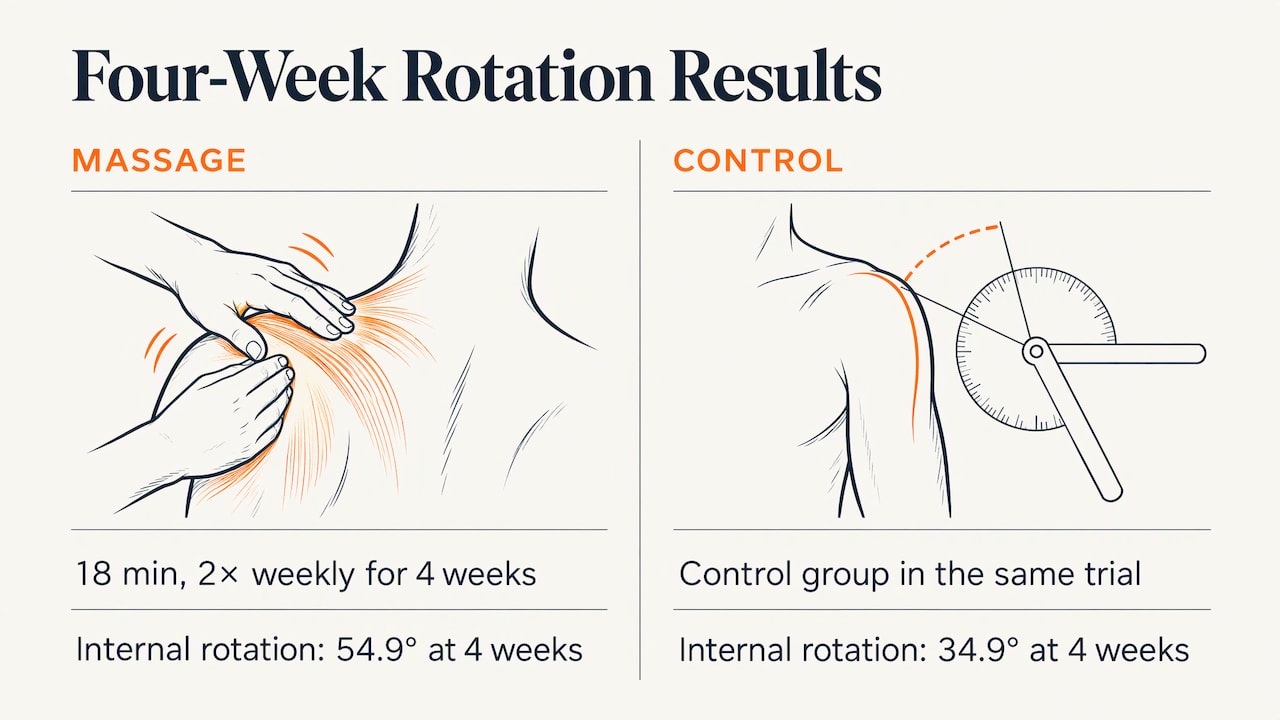
One trial worth knowing about used focused work on the back of the shoulder. In a 2012 randomized study, people with posterior shoulder tightness received 18 minutes of massage to the rear deltoid, infraspinatus and teres minor twice a week for four weeks. Their internal rotation range improved to 54.9 degrees, against 34.9 degrees in the control group. Those muscles sit right over and around the shoulder blade, so the result maps directly onto the kind of work a therapist does here.
What a therapist actually works on
A good session for shoulder blade pain looks at the whole chain, not one spot. Expect some combination of the following.
Assessment before pressure
Before working an injured shoulder, a therapist should check how it moves. The AMTA’s coverage of one well-known shoulder protocol describes checking active, passive and resisted range of motion so the work is planned around what is actually limited, and to screen for things like nerve entrapment, ligament pain or muscle strain. Stretching or pressing without that assessment can aggravate a strained muscle.
Upper back and scapular muscles
The rhomboids, mid and lower trapezius, levator scapulae and the rotator cuff muscles on the blade are the usual sites of knots. Deep tissue massage uses slow, sustained pressure here. Our deep tissue massage in Austin sessions are aimed at specific muscle tension and knots.
Trigger points
A trigger point is a tender, knotted spot in a muscle that can send aching to other areas. Pressure held on the point, followed by a stretch, is the classic approach. You can read how it feels and what it targets on our trigger point massage page.
The chest in front
If your shoulders round forward, the pectoralis minor shortens and tilts the blade. Releasing the chest often does more for the back of the shoulder than working the back alone. It also matters for impingement, covered below.
Myofascial release
Fascia is the connective tissue wrapped around muscles. Myofascial release uses slow, sustained, lighter pressure to ease restrictions. In a study reported in the AMTA journal, myofascial release improved flexion, rotation range and muscle strength after the first session, and combining it with proprioceptive neuromuscular facilitation (a stretch-and-contract technique) produced a larger cumulative effect. Our myofascial release explainer describes how it feels.
Shoulder impingement: where massage fits
Shoulder impingement means tendons and a fluid-filled cushion (the bursa) get pinched under the bony roof of the shoulder when you lift your arm. It typically hurts when you reach overhead or behind you, and the ache often reaches the shoulder blade area.
What the evidence supports is manual work on the contributing tissues. A 2019 study of 60 people with subacromial shoulder impingement, reported in the AMTA journal, concluded that manual therapy addressing the thoracic spine and posterior tightness decreased signs and symptoms. In plain terms: loosening the upper back, the back of the shoulder and the chest can give the joint more room.
For impingement, a therapist will usually:
- Work the muscles behind the shoulder and around the blade to restore rotation.
- Release the pectoralis minor and upper chest so the blade can tilt back.
- Mobilize the upper back so the shoulder blade sits and glides better.
- Avoid hard, direct pressure over an inflamed tendon or bursa.
That last point matters. Pressing hard on an irritated tendon rarely helps. If your pain is in the rotator cuff itself, our guide to massage for rotator cuff pain goes into it, and our general page on massage for shoulder pain covers the wider picture. If the shoulder has lost motion in every direction, see frozen shoulder massage.
What a session feels like, and how to make it work
Communication drives results. A therapist writing in the AMTA journal puts it bluntly: if a client says they can tolerate it, that is not the level to aim for, and the therapist may switch from trigger point work to myofascial release or gentle passive stretching to calm the pain. That matches how we work: Rick Snider, our licensed therapist, keeps checking in so pressure stays within your comfort range.
To get the most out of a visit:
- Describe the pain precisely. Is it a deep ache, a burn, a sharp pinch with overhead movement, or a pain that shoots into the arm or hand?
- Say what makes it worse. Desk hours, a certain lift, sleeping on one side, reaching into the back seat.
- Mention history. Past injuries, surgeries, falls, or a diagnosis such as impingement.
- Speak up on pressure. Deeper is not automatically better.
Expect some tenderness the next day after deeper work. Our page on soreness after deep tissue massage explains what is normal. If you are not sure which style suits you, Swedish vs. deep tissue lays out the difference.
When to see a doctor first
Massage suits muscular pain. Some shoulder blade pain is not muscular, and a few signs mean you should get medical care before any massage.
Cleveland Clinic advises seeing a healthcare provider if shoulder pain is severe or comes with swelling, lasts longer than a few days, gets worse instead of better, or stops you from using your arm. It says to seek immediate care when pain comes with sudden tingling, numbness, muscle weakness or paralysis, or a sudden inability to use the arm.
After an accident, a fall or a neck injury, or if a bone could be broken, get examined first. Massage therapists in the AMTA journal note that a doctor’s evaluation and any X-rays reduce the risk of working on an injury nobody has seen.
On safety in general, the NCCIH says harmful effects from massage appear to be low in risk. Rare serious problems, such as blood clots, nerve injury or fracture, have been reported mainly with vigorous techniques or in people at higher risk, such as older adults. So tell your therapist about any blood-clotting condition, blood thinners, osteoporosis or recent surgery, and let them set the pressure accordingly. Pain in the left shoulder blade together with chest pressure, shortness of breath or sweating is an emergency: call 911.
If you are unsure whether your problem calls for hands-on muscle work or a medical rehab plan, our comparison of physical therapy vs. massage can help you sort it out.
Between sessions: sleep and heat
Shoulder pain often feels worse at night. University of Iowa Health Care says this can come from sleeping position and pressure on irritated tissues. Its suggestions: avoid lying directly on the painful shoulder, sleep on your back or on the opposite side, prop the arm on pillows, or sleep semi-upright in a recliner. It also advises seeing a provider if the pain regularly disrupts sleep, limits daily activities, or does not improve after one or two weeks of home care.

Warmth can make tight muscles feel better before or after a session. Keep to heating pad safety rules on time and skin protection so a warm pad does not become a burn.
Beyond that, a few habits take pressure off the area between sessions:
- Change position every 30 to 45 minutes at a desk.
- Raise your monitor to eye level so your head is not pushed forward.
- Keep loads close to your body when you lift.
- Warm up the upper back before overhead or pulling work.
Who gets the most from this
Desk workers tend to carry tension where the neck meets the shoulder blade and in the chest. Regular sessions plus posture breaks give the best return.
Athletes who swim, climb, lift or throw load the scapular muscles repeatedly. Sports massage, priced at $120-$145 on our services page, works the muscles that stabilize and move the blade. Weightlifters can read massage for weightlifters, and cyclists who ride hunched will find massage for cyclists relevant. For deciding between styles during training blocks, see deep tissue vs sports massage.
Older adults often want a lighter touch and slower pace. Say so at the start of the session and the pressure is adjusted.
Our perspective
Shoulder blade pain is one of the problems people most often try to solve by pressing harder on the sore spot. In our experience as a practice built around communication, the better question is why the spot is sore. We look at how you hold your arm, what your chest and upper back are doing, and what you tell us about the pain.
That is why each session is adaptable. If a deeper technique is helping, we stay with it. If your body is guarding, we switch to something slower, such as myofascial release or gentle stretching, rather than push through. Our therapist’s healthcare and athletic background shapes how we read the shoulder, and our consent-driven approach means you set the limits.
We would rather you leave understanding what is tight and why than leave simply feeling pressed on.
Operations
Book a session in Austin
Howdy Massage offers deep tissue, Swedish, sports and trigger point massage, plus stretching and joint mobilization, in our Austin studio or at your location with mobile sessions. Published prices are $120-$245 for Swedish and deep tissue and $120-$145 for sports massage. Trigger point therapy and stretching and joint mobilization have no published price on our site. See the full list on our massage services page and book the session that fits your shoulder.

If headaches travel with your shoulder tension, our headache relief massage page explains how neck and upper back work can fit in.
FAQ
Where should massage focus for pain under the shoulder blade?
Usually on several areas: the rhomboids and trapezius between the blade and spine, the muscles on the blade itself, the levator scapulae toward the neck, and the chest in front. Tight pectoral muscles pull the blade forward, so treating only the back often gives incomplete relief.
Can anxiety cause shoulder blade pain?
Stress can keep the neck and upper back muscles tense for hours, and that tension is felt around the blades. Relaxation-focused Swedish massage is one option for that kind of tension. Pain with chest pressure, breathlessness or sweating is different and needs emergency care.
What should you avoid after a massage?
Go easy on intense workouts or heavy lifting the same day after deeper work, drink water, and avoid sleeping directly on a tender shoulder. Mild soreness for a day or so can follow deeper pressure. Pain that is sharp, worsening or comes with numbness should be checked by a doctor.
How often should I get a massage for shoulder tightness?
For ongoing tightness, a series works better than a single visit. The 2012 trial above used two sessions a week for four weeks, though a therapist will set the schedule around your pain, work and training. Tell us your goals and we will plan with you.
Is massage good for shoulder impingement?
It can help by easing the tight tissues around the joint, particularly the upper back, the back of the shoulder and the chest. The therapist works around the irritated tendon rather than pressing hard on it. If pain is severe or you have weakness, get it evaluated by a doctor first.
Sources
- Massage Therapy: What You Need To Know, NCCIH
- Effectiveness of massage therapy for shoulder pain: a systematic review and meta-analysis (2017)
- Massage Therapy for Neck and Shoulder Pain: A Systematic Review (2013)
- Effects and predictors of shoulder muscle massage for posterior shoulder tightness (2012)
- Massage for Shoulder and Back Pain, AMTA Massage Therapy Journal (2024)
- Shoulder Pain and Massage, AMTA Massage Therapy Journal (2019)
- Massage and Acute and Chronic Pain, AMTA Massage Therapy Journal (2022)
- Shoulder Pain Causes & Treatment, Cleveland Clinic
- Shoulder Pain at Night: Causes and When to Seek Care, University of Iowa Health Care
- Heating pad safety guidance