
Sprained Ankle Massage: When to Start and What Helps
Massage can be a useful part of ankle sprain recovery, but timing decides whether it helps or hurts. In the first couple of days, the injured area needs ice, compression and elevation, not hands-on work. Once the early swelling settles, a licensed therapist can work on the surrounding muscles and the stiff, guarded tissue around the joint, alongside the exercises that rebuild strength and balance. At Howdy Massage in Austin, Rick Snider, a licensed therapist with a healthcare and athletic background, builds sessions around that kind of sequence and adjusts pressure as you tell him how it feels.
TL;DR
- Skip massage on the injured ankle for the first 2 to 3 days. Use ice, compression and elevation instead.
- After the acute phase, massage around the ankle and in the calf can ease pain and stiffness while you work on range of motion.
- Massage supports rehab. It does not replace a medical check, bracing or strengthening and balance exercises.
- Get evaluated first if you can’t put weight on the ankle, the pain is uncontrollable, or it isn’t improving.
- A sports massage session in Austin is published at $120 to $145, in the studio or at your location.
Table of Contents
- Does massage help a sprained ankle?
- When can you massage a sprained ankle?
- Check the ankle before you book
- How long does a sprain take to heal?
- What massage can do at each stage
- Massage for ankle swelling: what to know
- What massage does not replace
- What a good session looks like
- Book sports massage for ankle recovery in Austin
- Our perspective
- FAQ
- Sources
Does massage help a sprained ankle?
It can, in specific ways and at specific times. A sprain is a stretched or torn ligament, the tough band that connects bones and holds the joint steady. Massage does not repair that ligament. What it can do is address the things that make a sprained ankle miserable after the first few days: stiffness, muscle guarding, a tight calf and a foot that feels clumsy.
The research is encouraging, though modest. A systematic review in the British Journal of Sports Medicine found moderate evidence supporting exercise and manual therapy techniques for pain, swelling and function after an acute ankle sprain. Manual therapy is hands-on treatment, and massage belongs to that family. The same review found strong evidence for early mobilization, meaning controlled movement rather than long rest.
For ankles that keep giving way, a critically appraised topic in the Journal of Sport Rehabilitation found level B evidence that plantar massage (massage of the sole of the foot) improves static postural control in people with chronic ankle instability. Those improvements showed up right after treatment. In plain terms, a foot that is better tuned to the ground can help you stand steadier.
Massage works best as one piece of a plan, not the whole plan. That is why the timing and the pairing with movement matter more than any single technique.
When can you massage a sprained ankle?
Not right away. The Children’s Hospital of Philadelphia advises avoiding heat and massage on a sprained ankle because both increase blood flow to the area and may make swelling worse. That guidance is about the fresh injury.
Here is how the early timeline looks, based on the guidance from U.S. medical bodies:
| Phase | Typical timing | What to do |
|---|---|---|
| Acute | Up to about 3 days after injury | Ice, compression wrap, elevation above heart level, no heat, no massage on the ankle |
| Subacute | About 3 to 7 days after injury | Active range-of-motion and stretching exercises; gentle hands-on work can begin once swelling and sharp pain are settling |
| Rehabilitation | Weeks 1 to 12, depending on severity | Strengthening, balance and functional training; massage as a support |
The American Academy of Family Physicians (AAFP) patient guide describes the acute phase as the first 3 days, with ice for 20 minutes every 2 to 3 hours, no heat, and a compression wrap with the foot raised above heart level. It describes the subacute phase as days 3 to 7, when active range-of-motion and stretching exercises become important to regain motion, reduce stiffness and promote blood flow for healing.
The American Academy of Orthopaedic Surgeons says swelling and pain in most cases last 2 to 3 days and recommends the RICE routine (rest, ice for 20 to 30 minutes 3 to 4 times a day, compression, elevation) for the first 48 hours.
A practical rule of thumb
If the ankle is still visibly puffy, warm, bruising is spreading, or pressing near the bone makes you wince, it is not time. If swelling is clearly going down, you can walk with a mostly normal stride and the pain is a dull ache rather than a sharp one, light massage in the surrounding muscles is a reasonable next step. When in doubt, tell your therapist exactly when the injury happened and how it has changed. A good session starts with that conversation.
Check the ankle before you book
Massage assumes you have the right diagnosis. Not every sore ankle is a simple sprain, and a fracture or a damaged tendon needs a medical answer first.
CHOP says to seek medical attention if you can’t put weight on the ankle, the pain is uncontrollable, or the injury isn’t improving. The AAFP patient guide adds that you should call your doctor if pain and swelling are not improving, or if you can’t flex and extend the foot during the acute phase.
Doctors also use timing to get the call right. The AAFP’s 2025 article on acute ankle sprains states that delaying the physical exam until 4 to 7 days after injury increases diagnostic accuracy of sprain severity. It also says the Ottawa Foot and Ankle rules help clinicians decide when an X-ray is not needed. If a sprain does not follow the expected course, the same article says further evaluation with MRI should be done to look for other causes such as talar fractures and peroneal tendon injuries.
The takeaway: if you can’t walk on it, or it isn’t improving on the expected schedule, see a doctor before booking a massage. If you have been checked and you have a sprain, you are in the right place.
How long does a sprain take to heal?
The AAFP patient guide gives these ranges: mild sprains recover in 1 to 2 weeks, moderate sprains in 2 to 4 weeks, and severe sprains in 6 to 8 weeks. High ankle sprains, which involve the ligaments above the joint, average 8 to 12 weeks.
The AAFP’s clinical article describes a functional treatment plan: pain control, limited immobilization for 5 to 10 days, early functional activity and targeted rehabilitation exercises. Recovery includes external ankle support and a targeted neuromuscular rehabilitation program for 8 to 12 weeks. Neuromuscular training means exercises that retrain how your muscles and nerves coordinate balance.
This matters for massage because the sessions that help most are placed along that timeline, not squeezed into one visit. Early on, you are protecting the joint. In the middle, you are restoring motion. Later, you are rebuilding strength and trust in the ankle.
What massage can do at each stage
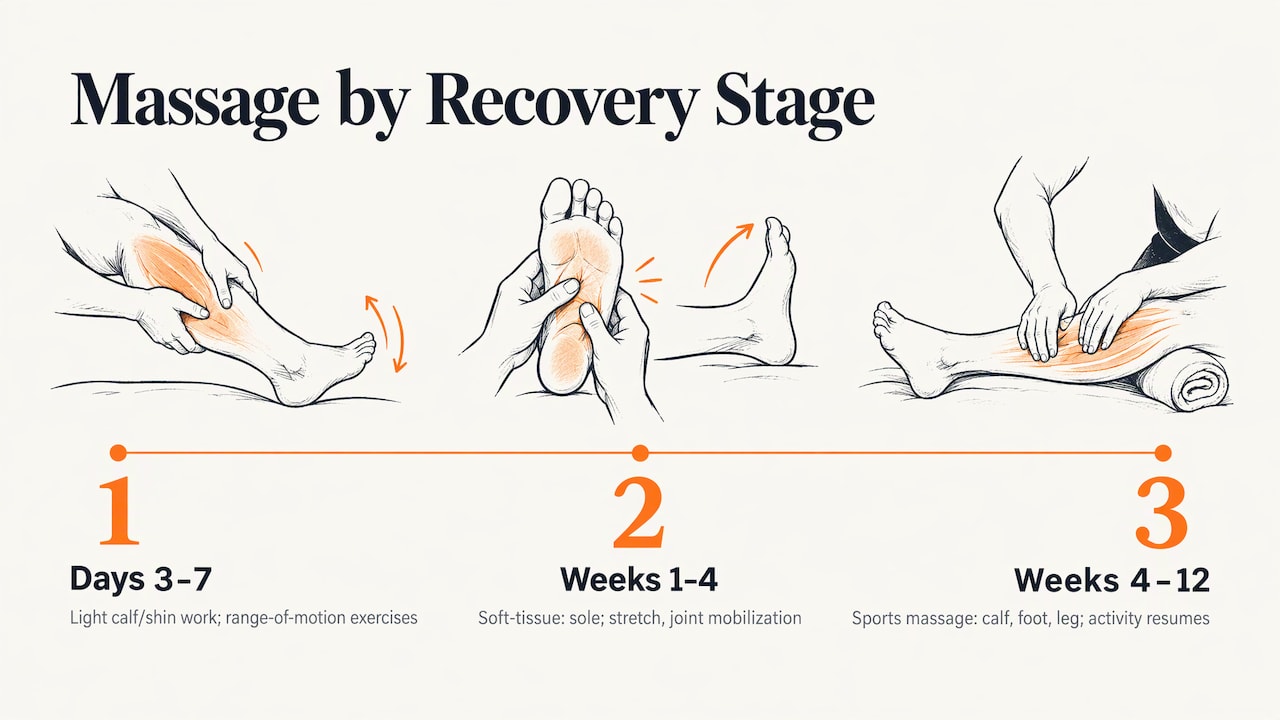
Days 3 to 7: ease the guarding
After a sprain, the muscles around the ankle often tighten to protect it. The calf, the muscles along the shin and the outside of the lower leg can get tense and sore, partly because you are walking differently. Work here, away from the injured ligament, is often the first useful step. Light pressure on the calf and shin can reduce that protective tension while you do your range-of-motion exercises.
Weeks 1 to 4: restore motion and feel
As swelling fades, a therapist can work the soft tissue around the joint with gentle, progressive pressure, including the sole of the foot. The plantar massage evidence above is the closest research match here, since foot-level work is tied to better standing balance. This is also when stretching and joint mobilization (slow, controlled movement of the joint) pair well with massage, so you leave a session moving better than you arrived.
A small study of calf massage in healthy people, published in 2017 and indexed on PubMed Central, reported improved ankle flexibility and balance after calf massage. It was not done on sprained ankles, so treat it as supporting context for why calf work is common, not as proof for sprains.
Weeks 4 to 12: support the return to activity
When you are back to walking, running or training, the calf, foot and lower leg take a lot of load. Sports massage here helps manage soreness from rehab work and keeps tissues from stiffening up as you ramp activity. If you are an athlete, this is the phase where regular sessions make the most sense. Our page on sports massage therapy in Austin explains what these sessions involve.
Massage for ankle swelling: what to know
Swelling is the top reason people search this topic, so it is worth being precise. In the first days, the proven tools for swelling are compression and elevation. Ice should be applied for 20 minutes every 2 to 3 hours in the acute phase, per the AAFP patient guide, and the wrap and elevation continue between icing.
Massage directly on a freshly swollen ankle is the thing to avoid. Later, when the swelling is lingering at the end of the day, work on the calf and lower leg and active movement of the foot are the safer route, and you should keep the ankle supported and elevated as before. If swelling is increasing rather than shrinking, that is a sign to call your doctor, not to book a session.
What massage does not replace
Two things are worth stating clearly because they decide how well you recover.
Rehab exercises. The AAOS describes a three-phase program for sprains. Phase 1 covers short immobilization, rest and ice. Phases 2 and 3 use exercises to improve flexibility, strength and proprioception, which is your body’s sense of where the joint is in space. The full program may take 2 weeks for minor sprains and 6 to 12 weeks for more severe ones. Massage makes that work more comfortable. The exercises are what rebuild the ankle.
Bracing for sport. The AAFP’s 2025 article recommends wearing an ankle brace during sports for up to 12 months after recovery to prevent repeat sprains, a Grade B recommendation. An earlier AAFP article on running injuries cites a meta-analysis of 46 systematic reviews suggesting functional bracing is the most important intervention for ankle sprain.
If your ankle keeps rolling long after the injury, a structured rehab approach matters. Some people add rehab-informed Pilates to build control and stability alongside manual care. For a broader look at how hands-on care and rehab fit together, see our guide on physical therapy vs. massage.
What a good session looks like
You should expect to be asked questions before anyone touches you. A useful first visit covers:
- When and how the injury happened, and whether a doctor has examined it.
- Where it hurts now, including the calf, foot, shin and the ankle itself.
- What you are doing for rehab, such as exercises, a brace or time off sport.
- Your goal, whether that is walking without a limp, getting back to a race or simply sleeping better.
Then the session works around the joint rather than on the freshest, most tender spot, with pressure you control. Mild soreness afterward is common with deeper work, but sharp or increasing ankle pain is a reason to stop and say so. Our therapist stays in communication throughout, so pressure and technique can change in the moment.
For tight, knotted spots in the calf or foot, trigger point work targets those specific areas. You can read more on trigger point massage. If the ankle strain has also left your heel or Achilles sore, our guides on massage for plantar fasciitis and Achilles tendonitis massage cover those neighboring problems.
Book sports massage for ankle recovery in Austin
Once your doctor has cleared the ankle and the early swelling is behind you, we can build sessions around your recovery stage. Sports massage at Howdy Massage is published at $120 to $145, and Swedish and deep tissue sessions at $120 to $245. Sessions take place in our Austin studio or at your location, so you do not need to drive on a sore ankle. Trigger point therapy and stretching and joint mobilization are also offered.

See the full list of options and book on our massage services page in Austin.
Our perspective
Most people who come to us with a sprained ankle are asking the wrong first question. They ask how hard we can press. The better question is when, and where.
We start with the person, not the ankle. How did it happen, what has a doctor said, what can you do on it today, and what do you need it to do next month? Those answers decide whether we work on the calf, the foot or the tissue around the joint, and how much pressure fits that day.
That is why communication is the core of how we work. Your comfort level guides the session from start to finish, and we adapt technique as your ankle changes from week to week. A healthcare background and an athlete’s understanding of getting back to training shape that approach.
We see massage as the part of recovery that keeps you moving well while the exercises rebuild the ankle. Done at the right time, it makes the rehab you are already doing easier to stick with.
Operations
FAQ
When should I start massaging a sprained ankle?
Wait until the acute phase, roughly the first 2 to 3 days, has passed and swelling is clearly improving. Until then, the guidance from U.S. medical bodies is ice, compression and elevation, with no heat and no massage on the ankle. After that, start with the calf and surrounding muscles using light pressure.
Can massage reduce swelling in a sprained ankle?
In the early days, compression and elevation are the tools for swelling, and massage on the injured area can make it worse. Later, work on the calf and lower leg, combined with movement and elevation, can fit into your recovery. If swelling is growing, call your doctor.
Is deep tissue or sports massage better for an ankle sprain?
Sports massage is built around recovery and return to activity, which suits the later weeks of a sprain. Deep tissue can work well on a tight calf once the ankle has settled. Either way, pressure stays comfortable and moves with your recovery stage. Our deep tissue vs. sports massage guide compares them.
How long does a sprained ankle take to heal?
The AAFP patient guide gives 1 to 2 weeks for mild sprains, 2 to 4 weeks for moderate ones and 6 to 8 weeks for severe ones. High ankle sprains average 8 to 12 weeks. If yours isn’t following that pattern, ask your doctor to re-evaluate it.
When should I see a doctor instead of booking a massage?
See a doctor if you can’t put weight on the ankle, the pain is uncontrollable, you can’t flex and extend your foot, or the injury isn’t improving. A doctor can rule out a fracture or tendon injury before massage begins.
Sources
- Systematic review of ankle sprain management, British Journal of Sports Medicine
- Plantar massage and postural control in chronic ankle instability, Journal of Sport Rehabilitation
- Sprained Ankle in Children and Teens, Children’s Hospital of Philadelphia
- Recovering From an Ankle Sprain, American Family Physician (2025)
- Sprained Ankle, OrthoInfo, American Academy of Orthopaedic Surgeons
- Management of Acute Ankle Sprains, American Family Physician (2025)
- Common Running Injuries: Evaluation and Management, American Family Physician (2018)
- Application of massage for ankle joint flexibility and balance (2017)