
Suboccipital Release Massage: What It Is and What It Can Do
Suboccipital release is a slow, sustained form of pressure applied to the four small muscles at the base of your skull, where the neck meets the head. It is most often used for tension-type headaches, a tight upper neck and that heavy, achy feeling behind the eyes after hours at a desk. A trained therapist can find the exact spot, set the pressure to your comfort level and treat the surrounding neck and shoulder muscles in the same session. That is why we treat it as part of a complete session rather than a stand-alone trick. This guide explains what the muscles do, what the research says, how to stay safe and what a session in Austin looks like.
TL;DR
- The suboccipitals are four small paired muscles under the base of the skull. Trigger point work on them is used for tension-type headache and upper neck tightness.
- In a randomized trial, 12 massage sessions that included suboccipital trigger point release improved perceived change and pressure-pain thresholds in people with tension-type headache.
- Pressure should be firm but never sharp. Numbness, vision changes, trouble speaking, severe dizziness or a sudden, unusual headache need urgent medical care, not massage.
- Our licensed therapist, Rick Snider, adjusts pressure and technique through ongoing communication, in our Austin studio or at your location.
Table of Contents
- What the suboccipital muscles are and where they sit
- What “release” actually means
- What the research says about headaches
- How often and how long: why dose matters
- Is your pain really from the suboccipitals?
- Staying safe with neck pressure
- Gentle self-care between sessions
- What a session looks like with us in Austin
- A worked example
- Promo: book neck and headache work in Austin
- Our perspective
- FAQ
- Sources
What the suboccipital muscles are and where they sit
The suboccipital muscles are four paired muscles just below the occipital bone, the ridge at the back of your skull. Two are “straight” muscles (rectus capitis posterior major and minor) and two are “oblique” muscles (obliquus capitis superior and inferior). They connect the skull to the top two neck vertebrae, the atlas (C1) and axis (C2).
You can find the area yourself. Put your fingertips on the back of your head and slide them down until you reach the bony shelf. The soft, ropey band just under that shelf, about an inch or so to each side of the center groove, is where these muscles sit.
They are small, but they work constantly. They make fine adjustments to where your head points, which matters whenever you read, drive, type or look at a phone. When your head drifts forward and your eyes stay locked on a screen, these muscles hold a long, low-level contraction. That is the usual recipe for a tender, knotted feeling at the base of the skull.
What “release” actually means
In a massage room, a suboccipital release is not a pop or a crack. The therapist rests your head in their hands, usually with you lying face up, and applies steady, gradual pressure to the tissue under the skull ridge. They hold it and wait for the tissue to soften, then repeat or move to the next spot.
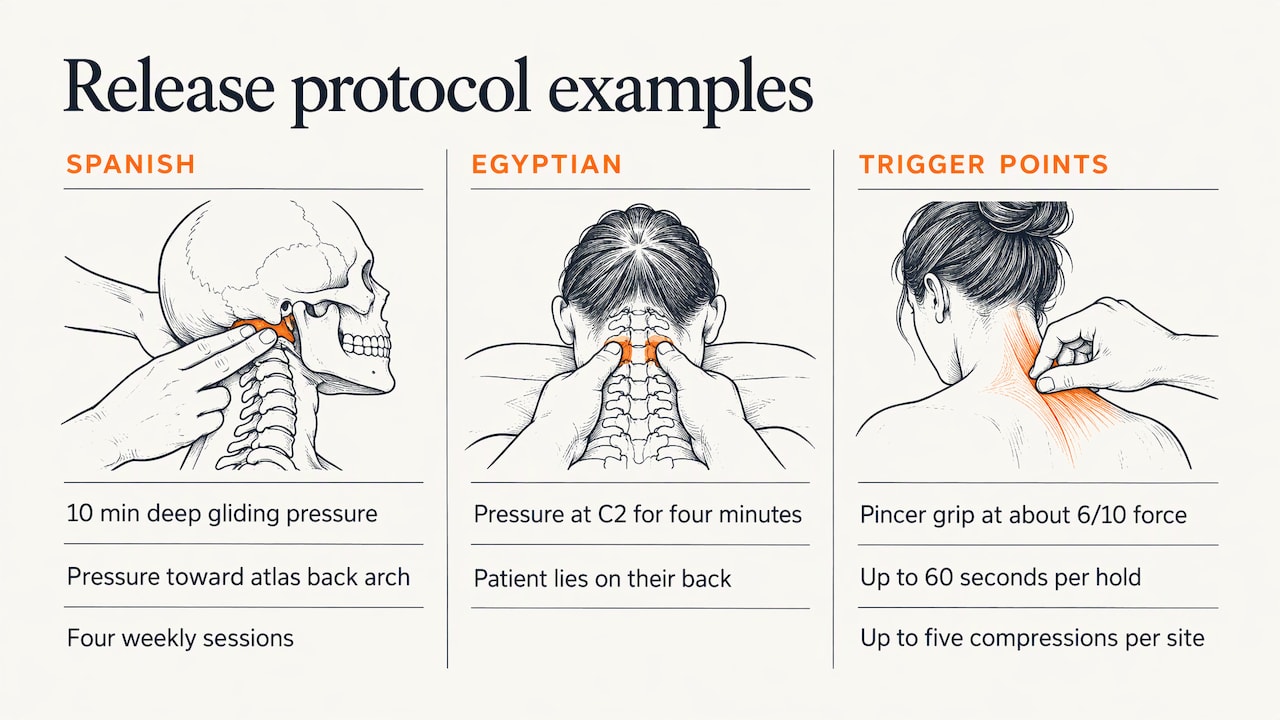
Research protocols give a sense of the dosage. A clinical trial record from Spain describes suboccipital soft tissue inhibition as 10 minutes of deep, progressive, gliding fingertip pressure toward the back arch of the atlas, in four weekly sessions. A planned Egyptian protocol in the ClinicalTrials.gov registry describes the patient lying on their back while pressure is applied to the C2 area for four minutes, until a “melting” sensation is felt.
In trigger point work generally, the protocol in the Moraska et al. trial used a pincer grip at a force that just brought on referred pain, about 6 on a 10-point scale. The pressure was held until the referred pain faded, the point softened, or 60 seconds passed. Up to five compressions were applied per site, with 10-second rests between them.
The takeaway for you: the pressure is meant to be strong but tolerable, around a 6 out of 10, never a 9. If you are clenching your jaw or holding your breath, the pressure is too much.
What the research says about headaches
The best-studied use is tension-type headache, the common kind that feels like a band of pressure around the head or a dull ache that starts at the base of the skull.
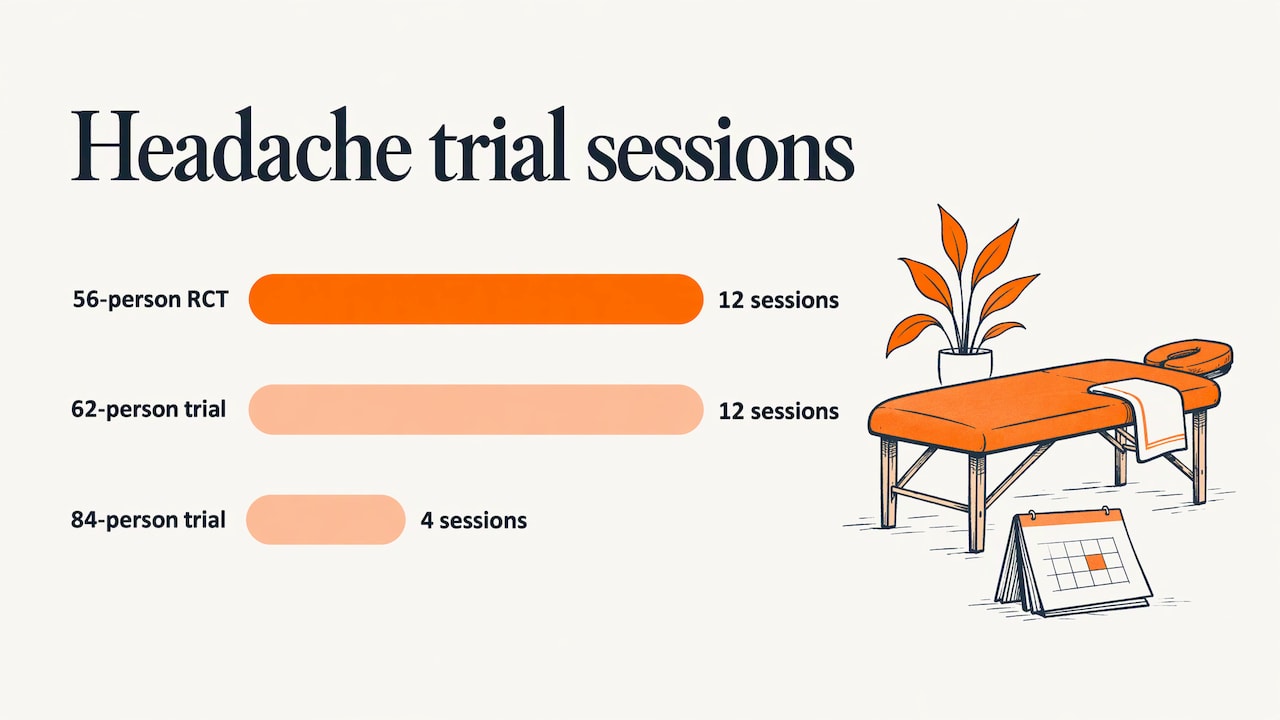
- Massage with suboccipital work. In a randomized, placebo-controlled trial of 56 people with tension-type headache, 12 sessions over six weeks included 20 minutes of trigger point release on the upper trapezius, suboccipital muscles and sternocleidomastoids. The massage group had better perceived clinical improvement and higher pressure-pain thresholds than placebo. Headache frequency fell in both groups, with no difference between them.
- Twice-weekly sessions. A PEDro-indexed trial of 62 people used 12 twice-weekly 45-minute sessions focused on trigger point release in the upper trapezius and suboccipital muscles. Pressure-pain threshold rose at all four muscle sites, with an immediate increase after the first session and a cumulative gain over baseline.
- Suboccipital inhibition on its own. In the Spanish trial of 84 people, four weekly sessions of suboccipital soft tissue inhibition improved headache impact, disability and craniocervical flexion at 8 weeks.
The pattern across these studies is that results build over a series of sessions, and that the neck and shoulder muscles around the suboccipitals are treated together. A single five-minute press rarely tells the whole story.
Clinicians also explain why early treatment of these muscles is encouraged. A clinical reasoning paper on tension-type and cervicogenic headache describes manual therapy to inactivate active trigger points in the upper trapezius, sternocleidomastoid, temporalis and suboccipital muscles as appropriate when peripheral sensitization dominates. The aim is to restore function and limit sustained nervous system facilitation, not only to dull the pain for an afternoon.
How often and how long: why dose matters
If you have had one neck massage that did little, the dose may be why. A Cochrane-style review of massage for neck pain found low-certainty evidence of little difference versus placebo overall for subacute and chronic neck pain, but a subgroup analysis showed a clinically important benefit for a high dose: at least 8 sessions over four weeks, each at least 30 minutes.
That matches the trial designs above, which all used a series of sessions over several weeks. A practical way to use this: if you are dealing with a recurring tight neck or tension headaches, plan a short block of regular visits and track how your head and neck feel, rather than judging by one appointment. Your therapist can adapt the plan as you respond.
If spasm is a big part of your neck pain, there is separate reading on muscle spasms and how they are treated in the medical literature. For the hands-on side, our own guide to massage for neck pain covers what helps and when to book.
Is your pain really from the suboccipitals?
Tight suboccipitals feel dull, achy and tender when pressed. They often come with stiffness turning the head and a sense of pressure behind the eyes. Desk work, long drives and phone use are common triggers, and our page on tech neck massage covers that posture pattern.
A different picture needs a medical evaluation first. UPMC’s occipital neuralgia page describes occipital neuralgia as piercing, shooting pain radiating from the base of the skull, often on one side, with a tender scalp. It advises seeing a doctor for sharp, intense scalp or neck pain that differs from your other headaches, or pain that seems like a migraine but lacks light sensitivity or nausea. Diagnosis takes a physical and neurological exam, and doctors may order imaging, since no single test confirms it.
See a doctor promptly, rather than booking a massage, if you have:
- A sudden, severe headache unlike any you have had
- Neck pain or headache with weakness, numbness, slurred speech, vision changes or severe dizziness
- Neck pain or headache after an injury, including a car accident or fall
- Shooting, electric pain at the base of the skull that does not behave like a muscle ache
A 2014 review of cervical artery dissection states that neck pain or headache with focal neurological symptoms after minor trauma warrants immediate medical evaluation for possible stroke. If those symptoms appear during or after any neck treatment, stop and seek emergency care.
Staying safe with neck pressure
The neck deserves care. The risks documented in the research come mainly from forceful cervical manipulation, the quick, high-velocity thrust technique, not from sustained soft tissue pressure. The clinical reasoning paper lists reported reactions to cervical manipulation ranging from stiffness to serious injury, and a MedLink Neurology review updated in March 2026 recommends screening risk factors, informed consent, trained practitioners, and stopping at the earliest neurologic symptom.
The same logic applies to any neck work:
- Keep pressure steady and gradual. No jabbing, twisting or sudden movements.
- Avoid forcing the head into rotation or extension while pressing.
- Mild soreness afterward can happen. The neck-pain review lists treatment soreness, sweating or low blood pressure as possible events.
- Tell your therapist about any history of neck injury, dizziness, blood vessel conditions, blood thinners or recent head trauma before the session starts.
Device use at home needs equal care. A case report linked vertebral artery dissection to a home massage chair with rotating neck probes, and calls for public awareness of safe neck massage practice. Strong, mechanical or jerky neck pressure is not the way to go.
Gentle self-care between sessions
Between visits, a gentle version of the same idea can keep the area from tightening back up. Lie on your back with your knees bent and place two fingertips, or a soft ball under a folded towel, at the base of your skull on one side. Let the weight of your head do the work.
- Start light and let your jaw and shoulders relax.
- Raise the pressure to a firm ache, about 6 out of 10, as in the trial protocol.
- Hold until the tenderness eases, up to about a minute, then rest briefly. The trial used no more than five compressions per spot with 10-second rests.
- Breathe slowly and stop if you feel tingling, numbness, lightheadedness or sharp pain.
Self-pressure is a way to maintain comfort, not a replacement for a session in which someone else can reach the muscles while you are fully relaxed, check the muscles around them and adjust in real time.
What a session looks like with us in Austin
Howdy Massage offers massage therapy in Austin, in our studio or at your home or workplace. Rick Snider is a licensed therapist with a healthcare background and athletic experience. Sessions are built around communication: you tell him what you feel, he adjusts pressure and technique, and the session stays within your comfort level.
For head and neck tension, the services that fit are:
| Service | Best for | Published price |
|---|---|---|
| Trigger point therapy | Knots and referred pain in the neck, shoulders and head | No published price |
| Deep tissue massage | Persistent tightness in the neck and upper back | $120 to $245 |
| Swedish / relaxation massage | Easing tension and calming the nervous system | $120 to $245 |
| Sports massage | Athletes with neck and shoulder load from training | $120 to $145 |
Prices are those published on our services page. Our page on headache relief with deep tissue and trigger point massage explains how we approach tension headaches.
A worked example
Imagine a software developer who gets a dull ache at the base of the skull by mid-afternoon, with stiffness turning left. Nothing alarming: no numbness, no sudden onset, no injury. A sensible plan based on the research above:
- Book a first session and describe the pattern, including when it started and what eases it.
- Plan a short block of regular sessions rather than one visit, since the studies measured results over several weeks.
- Between visits, use gentle self-pressure and break up long screen stretches.
- Reassess after the block. If the pattern changes or a red flag appears, see a doctor.
Promo: book neck and headache work in Austin
If tension at the base of your skull keeps coming back, you can book a trigger point, deep tissue or Swedish session with Rick Snider in our studio or at your location. Tell him where it hurts and how firm you like the pressure, and he works within that.

See options and book on our massage services page.
Our perspective
We see the base of the skull as a place where comfort and communication matter more than force. The suboccipitals are small and sit close to the head, so we work slowly, ask often and let your feedback set the pressure.
Pain there rarely lives alone. The upper trapezius, the muscles along the side of the neck and the shoulders usually share the load, so we look at the whole region instead of pressing one spot. That is also how the research protocols are built.
Our approach combines a healthcare background with athletic experience, consent-driven practice and sessions adapted to your goal, whether that is pain relief, recovery or simply relaxing. If you want hands-on help with a tight neck or recurring tension headaches, a series of sessions with us is where we would start.
Operations
FAQ
How do you do a suboccipital release on yourself?
Lie on your back and rest two fingertips or a soft ball at the base of your skull, letting your head’s weight create the pressure. Aim for a firm but tolerable ache, about 6 out of 10, and hold up to a minute, as in the trial protocol. Stop with any numbness, tingling or sharp pain.
Will a neck massage help a headache?
For tension-type headache, a series of massage sessions that included suboccipital trigger point release improved perceived change and pressure-pain thresholds in a randomized trial. Results build over several sessions. A sudden, severe or unusual headache needs a doctor first.
What are the suboccipital muscles?
They are four small paired muscles under the base of the skull that connect it to the first two neck vertebrae. They fine-tune head position, so they tire when you look at screens or hold your head forward for hours.
Can occipital neuralgia go away on its own?
Only a doctor can say. UPMC describes piercing, shooting pain from the base of the skull and advises a medical exam to confirm the cause. Get that exam before treating it as muscle tightness.
Sources
- Suboccipital muscles, anatomy overview
- Myofascial trigger point-focused head and neck massage for tension-type headache (PMC)
- Suboccipital release protocol, ClinicalTrials.gov NCT06703385
- Suboccipital soft tissue inhibition trial, ClinicalTrials.gov NCT01550276
- PEDro record of the twice-weekly massage trial
- Massage for neck pain (PMC)
- Clinical reasoning for manual therapy in tension-type and cervicogenic headache (PMC)
- Occipital neuralgia, UPMC
- Cervical arterial dissections and cervical manipulative therapy, 2014 review
- MedLink Neurology, neurologic complications of manipulation
- Home self-massage device and vertebral artery dissection case report
- Muscle spasms and how they are treated