
Swedish Massage Benefits: What It Does and Who It Helps
Swedish massage is the best-known form of massage for a reason: it eases muscle tension, calms the nervous system and leaves most people feeling looser and more relaxed. It uses long, flowing strokes at light to medium pressure, so it suits first-timers, desk workers, athletes in a recovery week and anyone who wants to downshift. In Austin, you can book it in our studio or have it brought to you with mobile service.
Below: what happens in a session, which benefits have research behind them, who gets the most from it, and how to book one that fits your body.
TL;DR
- Swedish massage combines long gliding strokes, kneading, circular movements, tapping and vibration to relax muscles and calm the body’s stress response.
- Research points to benefits for relaxation, blood pressure, back pain and knee osteoarthritis pain, with a systematic review of 11 studies reporting beneficial results in most cases.
- It is a good first massage, a good maintenance massage, and a good recovery tool between hard training days.
- Tell your therapist about blood thinners, blood clots, high blood pressure or any chronic condition before you start.
- Our Swedish / Relaxation Massage in Austin is listed at $120 to $245 per session, in studio or at your location.
Table of Contents
- What Swedish massage is
- The benefits of Swedish massage, one by one
- Who gets the most out of it
- Swedish or deep tissue?
- Safe use: who should check first
- Getting the most from a session
- What a Swedish massage with us looks like
- Our perspective
- FAQ
- Sources
What Swedish massage is
Swedish massage is a full-body style built around a handful of strokes. Johns Hopkins Medicine describes it as long, smooth strokes that knead and compress the muscles, with deep circular movements, vibration and tapping. You will usually hear these called:
- Effleurage: long gliding strokes that warm up tissue and spread oil or lotion.
- Petrissage: kneading and lifting of larger muscles such as the shoulders, hips and thighs.
- Circular friction: small circular movements that work into tight spots around joints and shoulder blades.
- Tapotement and vibration: light rhythmic tapping or shaking to wake up or settle muscles.
The pressure is adjustable. Swedish is not “light only.” A therapist can work firmly through a tight upper back and then ease off over a tender area, and you steer that by telling them what feels right. If you want a deeper dive into the style itself, our page on what a Swedish massage is walks through a typical session.
The benefits of Swedish massage, one by one
Relaxation and stress relief
This is the benefit most people book for. Johns Hopkins Medicine explains that massaging muscles and soft tissue stimulates nerves, increases blood flow and eases stress in the muscles, and that the soothing rubbing action releases tension and creates a sense of calm. The same page lists anxiety and stress reduction among the reasons people use massage.
In practice, the long, rhythmic strokes of Swedish are the reason it works well for winding down. There is nothing sharp or sudden to brace against. Breathing slows, shoulders drop, and many people notice their jaw unclench. If your stress lives in your body as a tight neck, tense shoulders or a clenched back, this is the style that goes after that directly.
Lower blood pressure readings
A 2006 National University of Health Sciences study, summarized in Massage Professionals Update, found Swedish massage had the greatest effect on blood pressure readings among the therapeutic massage styles compared. A 1999 Touch Research Institute and University of Miami study cited in the same piece found that only the massage group showed decreases in sitting systolic and diastolic blood pressure and in cortisol, a stress hormone.
That does not make massage a blood pressure treatment, and your doctor manages that. It does mean a calm, relaxation-focused session is a sensible fit for people who run high on stress.
Relief from back pain and muscle tension
Muscle tension is the everyday complaint behind most massage bookings: the upper back after a week at a laptop, the lower back after a long drive, the calves after a run. A 2017 systematic review by Barreto and Batista, published on PubMed, looked at 11 studies of Swedish massage across groups that included nurses, infants, pregnant women, older adults and cancer patients. It found beneficial results in most cases, including reduced lower-back pain in nurses, and concluded Swedish massage can be used as a therapy, with its use for prevention highly recommended.
The National Center for Complementary and Integrative Health (NCCIH), part of the US National Institutes of Health, adds that a 2015 review of 25 studies with 3,096 participants found short-term improvements in pain after massage for both acute and chronic low-back pain. If back pain is your main reason for looking, our guide to massage for back pain covers what to ask for and when to book.
Joint pain from osteoarthritis
The NCCIH provider digest, Massage Therapy for Health: What the Science Says, reports a 2006 randomized trial of 68 adults with knee osteoarthritis. After 8 weeks of standard Swedish massage, they showed statistically significant improvements in pain and physical function. The same digest cites a 2017 review of 7 randomized trials (352 participants) that found low- to moderate-quality evidence that massage therapy beat non-active therapies for reducing pain and improving function in arthritis.
If stiff joints are what bring you in, see our page on massage for arthritis pain for what a session can focus on.
Better circulation and looser tissue
The strokes in Swedish massage are typically directed toward the heart, and Johns Hopkins Medicine notes that massage increases blood flow to the muscles it works. Warmer, better-supplied tissue is part of why muscles feel softer and move more easily afterward. Many people describe an easier range of motion in the neck and shoulders after a session, which is why this style pairs well with stretching.
Recovery between workouts
Johns Hopkins Medicine lists sports and overuse injuries among the conditions people use massage for. For athletes, Swedish is a useful lighter option in a heavy training block: it keeps you moving through sore muscles without adding stress to tissue that is already taxed. For a day-after-the-long-run feeling, take a look at our page on massage for DOMS, and for more on easing soreness generally, this overview of easing sore muscles is a helpful companion.
Mood and general well-being
Hopkins also lists depression among the reasons people turn to massage, and the touch, quiet and time away from your phone are a large part of the appeal. Many clients simply say they sleep and feel better in the days after a session. Treat it as one part of looking after yourself alongside sleep, movement and professional care where you need it. For people with fibromyalgia, research on other approaches is also growing, such as TMS and fibromyalgia, and it is worth discussing the full picture with your physician.
Who gets the most out of it
| If you are… | Why Swedish fits | What to tell your therapist |
|---|---|---|
| A desk worker | Eases shoulders, neck and lower back after long sitting | Where you hold tension and how many hours you sit |
| An athlete in training | Keeps muscles loose and helps you unwind between hard sessions | Your training schedule and any sore spots |
| New to massage | Predictable, flowing and easy to adjust | How much pressure feels comfortable |
| An older adult | Gentle, steady work on stiff areas | Medications, joint replacements and chronic conditions |
| Stressed or run down | Slows the pace and brings your body into a calmer state | What you want from the hour: quiet, or a focus area |
Swedish or deep tissue?
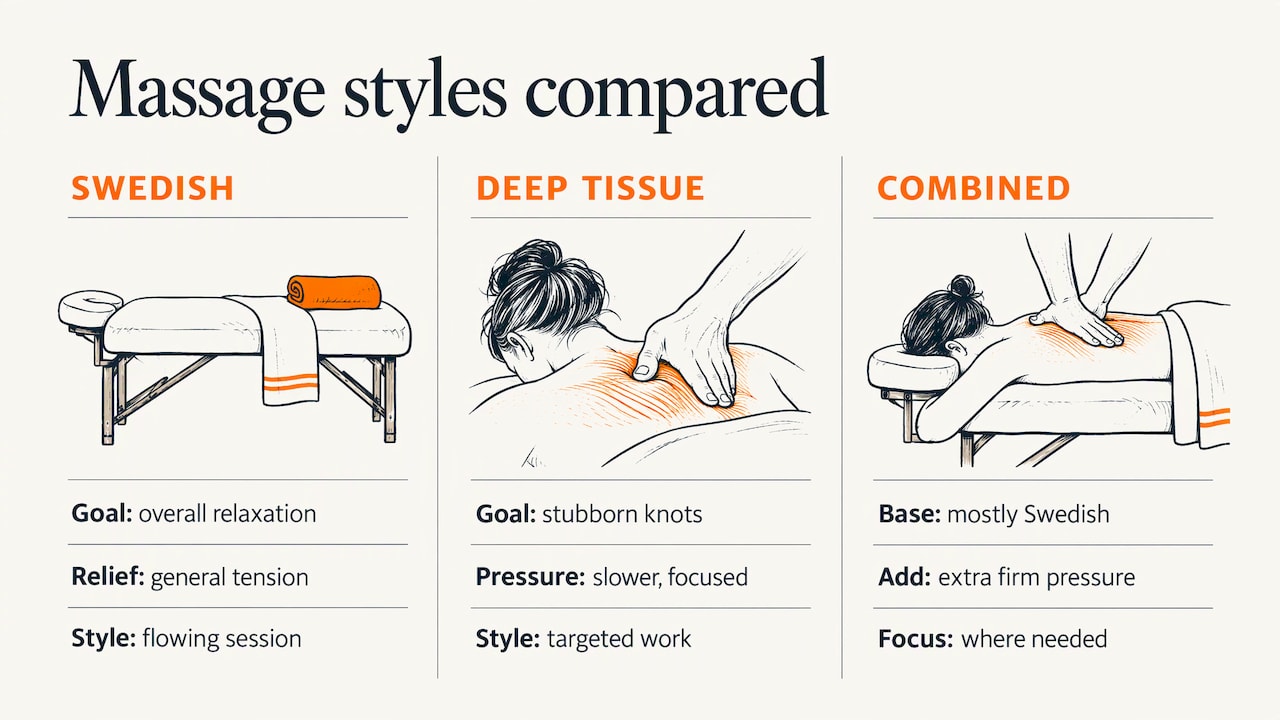
Choose Swedish when you want overall relaxation, general tension relief and a flowing session. Choose deep tissue when you have specific, stubborn knots and want slower, more focused pressure on them. The two overlap: a session can be mostly Swedish with extra firm work where you need it. Our comparison of Swedish vs. deep tissue massage lays out how to decide, and you can always discuss it at the start of your appointment.
Safe use: who should check first
Swedish massage is generally gentle, and a 2026 evidence map of systematic reviews, published in PMC, found no serious adverse events attributed to massage in the 7 reviews that collected that data. Still, a few situations call for a conversation first:
- Chronic health condition: Johns Hopkins Medicine advises checking with your healthcare provider before scheduling a massage if you have one.
- History of blood clots, frailty or severe rheumatoid arthritis: Hopkins notes that deeper massage may not be advised in these cases. Raise it with your provider and your therapist.
- Blood thinners, low platelet counts or bleeding disorders: NAFKAM lists strong, forceful massage as a contraindication for these groups. Ask your doctor what level of pressure is right for you.
- High blood pressure: Massage Professionals Update advises relaxation-oriented styles such as Swedish and healthcare permission if blood pressure is not controlled.
- History of trauma: Hopkins notes that some people with a history of physical abuse or trauma may not be advised to have deeper work. A session you can pause or redirect at any time matters here.
New pain that is sharp, sudden or unexplained, swelling in one leg, or numbness belongs with a doctor before a massage table.
Getting the most from a session
- Say what you want. “Relaxation,” “my neck is tight,” or “I ran a half marathon on Sunday” all steer the hour.
- Give feedback on pressure. Pressure should feel like good work, never like bracing. Speak up at any point.
- Drink water and take it easy afterward. Give yourself a little time rather than rushing to a hard workout.
- Book regularly if tension keeps returning. The trials above used repeated sessions, such as the 8 weeks of massage in the knee study, so a pattern usually beats a one-off.
- Tell your therapist about changes. New medications, injuries or a flare-up all affect how a session should go.
What a Swedish massage with us looks like
Swedish / Relaxation Massage is one of our core services, and it is available in our Austin studio or at your location with mobile service. Our sessions are built around communication, so the work stays adaptable to your comfort level and your goals, whether that is pain relief, recovery or simply relaxation. Rick Snider, our licensed therapist, draws on a healthcare background and athletic experience, and our consent-driven practice welcomes a diverse clientele.
Swedish / Relaxation Massage is listed at $120 to $245 per session on our massage services page. Deep tissue is listed at the same range, and sports massage at $120 to $145.
Ready to feel the difference? Read more about Swedish massage in Austin and book a session in the studio or at home.
Our perspective
Most people who come to us do not need a lecture on massage. They need to feel their shoulders drop. Swedish is the style where that happens most reliably, because the pace is steady and the work is easy to adjust.
What we care about is that the hour matches you. A desk worker with a tight neck, a cyclist after a big weekend and an older client with stiff knees each want something different from the same set of strokes. That is why we talk through goals and comfort before and during the session, and why consent and communication are part of how we work, not an add-on.
Rick brings a healthcare background and his own athletic experience to the table. That means he can work firmly where it helps and lightly where it doesn’t, and keep the session relaxing while still targeting the knots that bother you. If you are choosing between Swedish and something deeper, tell us what you feel and we will shape the session around it.
Operations
FAQ
Is Swedish massage good for stress?
Yes. Johns Hopkins Medicine lists anxiety and stress reduction among the reasons people use massage, and the slow, rhythmic strokes of Swedish are well suited to calming the body. Studies of Swedish massage have also found lower blood pressure readings, a common marker of stress load.
How often should I get a Swedish massage?
It depends on your goal. For ongoing tension from desk work or training, a regular pattern tends to work better than a single visit, and the knee osteoarthritis trial above ran for 8 weeks. Talk through a schedule that suits your body and budget with your therapist.
Does Swedish massage hurt?
It should not. Pressure runs from light to firm, and you set the level. Some tender spots can feel intense for a moment, but you can ask for less pressure at any time.
Can I get a Swedish massage if I have a medical condition?
Often yes, but check with your healthcare provider first if you have a chronic condition, high blood pressure, a history of blood clots or you take blood thinners. Then let your therapist know so the pressure and areas worked can be adjusted.
What is the difference between Swedish and deep tissue massage?
Swedish uses flowing strokes for whole-body relaxation and tension relief. Deep tissue uses slower, firmer pressure on specific knots and tight layers of muscle. Many sessions blend both.
Sources
- Massage | Johns Hopkins Medicine
- Massage Therapy: What You Need To Know | NCCIH
- Massage Therapy for Health: What the Science Says | NCCIH
- Swedish Massage: A Systematic Review of its Physical and Psychological Benefits | PubMed
- Hypertension: Massage Indication or Contraindication? | Massage Professionals Update
- Use of massage therapy for non-painful health conditions | PMC
- Massage (Classical/Swedish) | NAFKAM
- DOMS Relief: What Actually Works to Ease Sore Muscles
- TMS for Fibromyalgia: What the Research Shows