
Tension Headache Massage: What It Does and What to Expect
Massage works on the muscles that tend to drive a tension headache: the base of the skull, the upper shoulders, the sides of the neck, the jaw and the temples. The most useful approach is slow, targeted trigger-point and deep tissue work on those areas, delivered by a therapist who adjusts pressure as you go. If you live in Austin, that is what our headache relief massage is built around.
TL;DR
- Tension headaches often involve tight muscles in the neck, shoulders, jaw and scalp, which is exactly where a massage therapist works.
- Trigger-point release, deep tissue and myofascial techniques on the neck and head are the approaches studied most for this type of headache.
- In published studies, people reported less pain and fewer headaches after massage programs, with relief that varied from person to person.
- Pressure should be firm but never sharp. Good communication with your therapist matters more than depth.
- Sudden, severe headaches, or headaches with fever, stiff neck, confusion or weakness, need medical care, not massage.
Table of Contents
- Why massage fits a tension headache
- What the research says about massage and tension headaches
- Which massage works best for tension headaches
- What happens in a headache-focused session
- How often to go
- Between sessions: gentle self-care
- Tension headache or something else?
- Safe use: tell your therapist what applies to you
- Our perspective
- Book a headache-focused session in Austin
- FAQ
- Sources
Why massage fits a tension headache
A tension-type headache usually feels like a dull, steady band of pressure around the head, often with sore muscles in the neck and shoulders. It is the most common headache type, and the MSD Manual notes that doctors may recommend massaging the head and neck for it. Mayo Clinic lists massage therapy among the stress-reduction therapies that may help, alongside biofeedback, cognitive behavioral therapy and acupuncture.
The logic is simple. Hours at a desk, a phone held low, clenched teeth and hard training all load the same group of muscles. Those muscles develop tender knots, called trigger points, that can refer pain into the head. A therapist can find those spots, work them directly and loosen the tissue around them. That is hands-on work you cannot fully do on your own back and neck.
What the research says about massage and tension headaches
The research is small but encouraging, and it points to the same muscles each time.
Fewer headaches per week. In an early study of people with chronic tension headaches, a 30-minute muscle-specific massage protocol reduced average headache frequency from 6.8 per week to 2.0 per week, and the drop began within the first week. The authors also noted that on four occasions, a person who arrived with an active headache left without it, and nobody left with a new one.
Less pain, better pressure tolerance. A randomized trial gave people with tension-type headache 12 sessions of 45-minute trigger-point massage over six weeks. Participants reported greater pain reduction with massage than with the comparison treatments, and their pressure-pain thresholds improved only in the massage group. The authors concluded that six-week programs focused on myofascial trigger points in the neck muscles are helpful, particularly for people with eight or more headaches a month.
Patient-reported relief. A 2021 systematic review found that people rated partial to full headache relief from massage between 33.0% and 64.5%, averaging 45.2%.
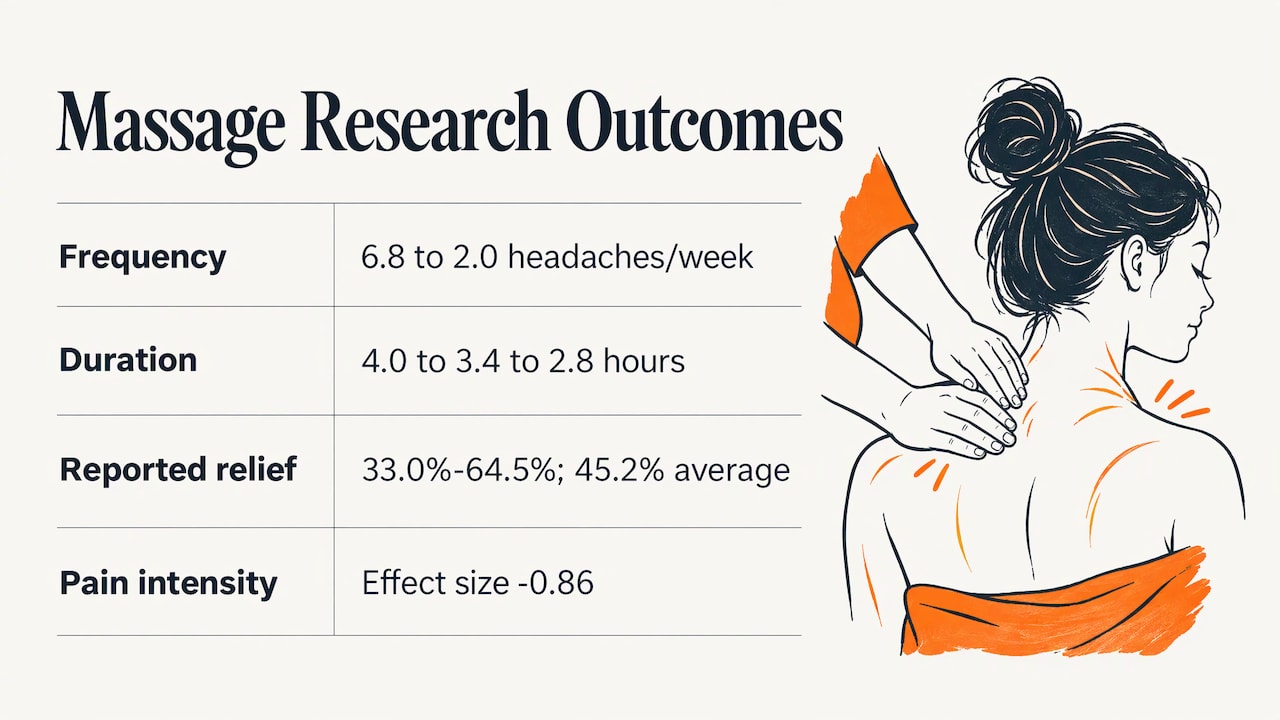
Myofascial release. A 2024 meta-analysis found that myofascial release reduced tension-type headache pain and improved headache-related disability, with a pain-intensity effect size of -0.86.
Duration. In a pilot study of twice-weekly 45-minute massage over six weeks, the average length of a headache fell from 4.0 hours at baseline to 3.4 hours during treatment and 2.8 hours at follow-up.
What this means for you: massage is a reasonable, well-tolerated option, especially when headaches are frequent and your neck and shoulders are visibly tight. A series of sessions has more support than a single visit, and the best results in the studies came from work aimed at specific muscles rather than a general rub.
Which massage works best for tension headaches
The studies describe a consistent pattern. Here is how the main approaches differ and what each does for headache-prone muscles.
| Approach | What it targets | Best when |
|---|---|---|
| Trigger point release | Tender knots in the upper trapezius, base of the skull, sides of the neck and temples | Pain refers into the head from a specific sore spot |
| Deep tissue | Layers of tight muscle in the neck, upper back and shoulders, using slow, firm strokes | Chronic tightness from desk work or training |
| Myofascial release | The connective tissue around muscles, with sustained, gentle pressure | Broad stiffness through the neck, chest and shoulders |
| Swedish | Whole-body relaxation with lighter pressure | Stress is the main driver and you want to settle your nervous system |
| Jaw and temple work | Masseter and temporalis muscles | You clench or grind your teeth, or headaches sit at the temples |
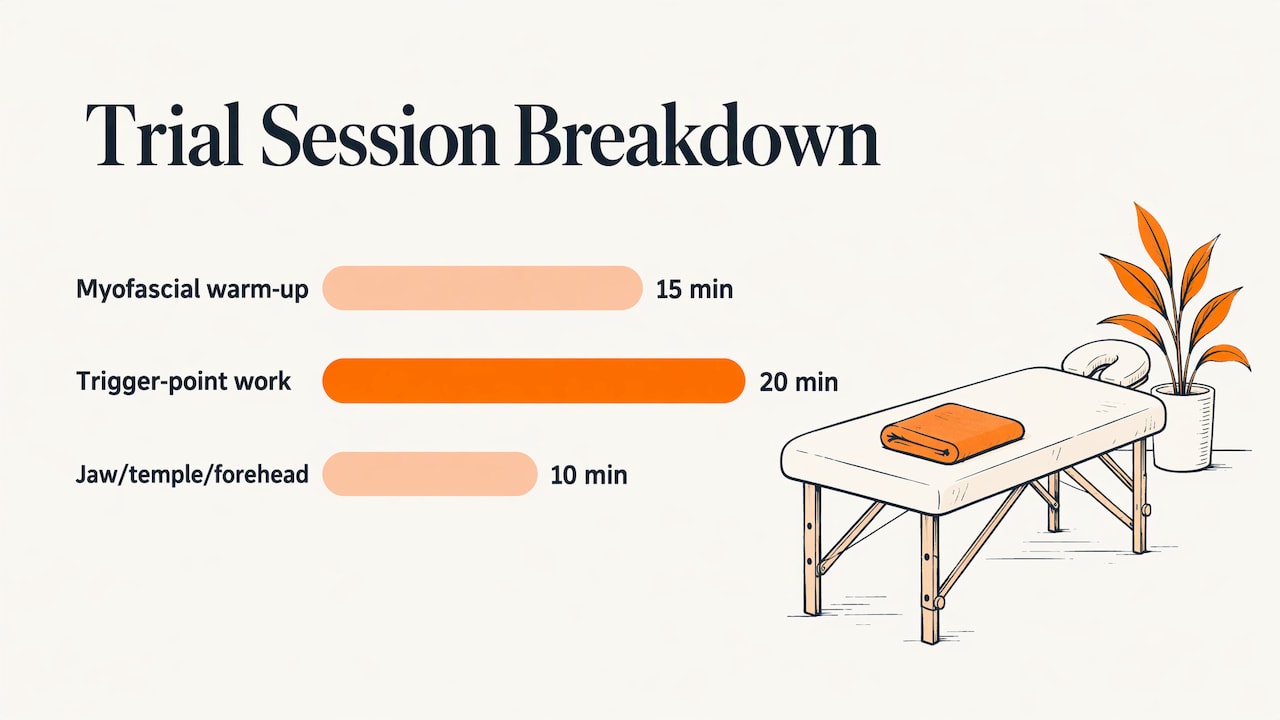
The trial protocol is a useful model. It spent 15 minutes warming the back, shoulders, chest and neck with myofascial release, 20 minutes on trigger-point release in the upper trapezius, the muscles under the skull and the large neck muscles, and 10 minutes on the jaw, temple and forehead muscles, with pressure kept just at the level that produced referred pain. A case series on chronic tension-type headache followed a similar pattern over six 45-minute sessions in three weeks, and every technique was kept at or below 8 on a 10-point pressure scale set by the client.
The American Massage Therapy Association describes deep tissue and trigger point work for headaches as firm, slow pressure to relax strained muscles that may be behind the pain. Its therapist source stresses that the right amount of pressure matters, and that working one side of the head at a time makes sure each muscle is treated.
Two of our own pages go deeper on the muscles involved: suboccipital release for the small muscles at the base of the skull, and massage for TMJ when the jaw is part of the story.
What happens in a headache-focused session
A good session starts with a conversation, not with pressure. You describe where the headaches start, how often they come, what makes them worse and whether you grind your teeth or sit long hours. The therapist then works in a sequence that mirrors the studies:
- Warm the large muscles. Broad, slower strokes through the upper back, shoulders and neck release the surface tension so the deeper work is more comfortable.
- Find and work the trigger points. The therapist presses into tender spots in the upper shoulders, the base of the skull and the sides of the neck until the tissue softens. You may feel the ache travel toward your head. That is the referral pattern, and it tells the therapist you have found a relevant spot.
- Address the head, jaw and temples. Lighter pressure and small friction strokes on the scalp, temples and jaw muscles finish the session.
- Check in. You rate the pressure throughout. Firm should feel like a productive ache, never sharp or something you hold your breath through.
If you want to compare techniques, our guides to trigger point massage and myofascial release explain how each feels. For the neck specifically, see massage for neck pain.
How often to go
The trials that showed results used a series, not a one-off: 45-minute sessions twice a week for six weeks in the randomized trial, and six sessions over three weeks in the case series. That is an intensive research schedule, and most people do not need to mirror it. A practical approach for frequent headaches is a few sessions close together to calm the muscles, then a maintenance rhythm that matches your triggers. Someone with a desk job and weekly headaches may want a regular monthly or twice-monthly visit. Someone whose headaches follow a stressful stretch may only need sessions during that period.
Swedish and deep tissue sessions at Howdy Massage are listed on our services page at $120 to $245 depending on the session, and sports massage at $120 to $145. Trigger point therapy and stretching with joint mobilization are also offered, and we do not publish a price for those. Ask us about session length when you book, because longer sessions give the neck, jaw and scalp each their own time.
Between sessions: gentle self-care
Light self-massage can complement professional work. The UMass Memorial guide suggests thumb circles along the ridge at the base of the skull, steady pressure at the notch under the skull, light to medium fingertip pressure on the scalp, temples and forehead, and light rubbing along the sides of the neck and behind the ears. It also suggests warmth before and a cool compress after. The guide’s rule is the one to follow: stop if discomfort is sharp or does not ease, and check with a health care provider or physical therapist before starting.
If headaches show up after training, hydration, sleep and warm-up habits are worth a look, and this overview of post-workout headache causes covers what else can contribute. Athletes who get headaches along with heavy neck and shoulder tightness can also book a sports massage.
Tension headache or something else?
Massage is for muscle-related tension headaches. Migraines are a different condition with different treatments, and some people with frequent migraines look at options such as TMS therapy for migraines under a physician’s care. If your headaches come with nausea, light sensitivity or visual changes, or you are unsure which type you have, start with your doctor, and massage can follow once you have a diagnosis.
Get medical care first, not a massage, if any of these apply. Mayo Clinic advises emergency care for:
- a sudden, very severe headache
- a headache after a head injury or fall
- fever, stiff neck or rash
- confusion or a seizure
- double vision, weakness, numbness or difficulty speaking
- pain that keeps getting worse despite treatment
The MSD Manual adds temple tenderness or jaw pain when chewing, and red eyes with halos around lights, to the list of signs that need a doctor right away.
Safe use: tell your therapist what applies to you
The NCCIH says the risk of harmful effects from massage appears low when a trained practitioner does it. Rare serious problems, including blood clots, nerve injury and bone fracture, have been reported, some linked to vigorous techniques or to higher-risk people such as older adults. It also advises against using massage to put off seeing a health care provider about a medical problem. In practice:
- Tell your therapist about blood-clotting conditions, blood thinners, osteoporosis, recent injuries, pregnancy and any neck or spine problem before the session starts.
- People with health conditions and pregnant women may need to avoid some types of massage and should check with their health care provider first.
- Speak up the moment pressure becomes sharp. Deeper is not better for a headache-prone neck.
The NCCIH also suggests asking about a therapist’s training, experience and credentials, the number of sessions you might need, cost and insurance coverage. At Howdy Massage, Rick Snider is a licensed therapist, and you are welcome to ask about any of it.
Our perspective
We approach a tension headache as a muscle pattern with a person attached. Two clients can describe the same dull band across the forehead and need completely different work: one carries it from the base of the skull after long desk days, another from a clenched jaw, another from heavy training and poor recovery.
That is why communication runs through the whole session. We ask where the headache starts, then adjust pressure and technique as your body responds, so the work stays effective without tipping into pain. Deep tissue and trigger point therapy are the tools we reach for most often for headache patterns, with Swedish work when relaxation is the priority.
Rick’s healthcare background and athletic experience shape how he reads the neck, shoulders and jaw. We see clients come in for chronic pain, recovery and relaxation, and a clear consent-driven approach lets every client set the limits that feel right to them.
Operations
Book a headache-focused session in Austin
Howdy Massage offers deep tissue, Swedish, sports and trigger point work in our Austin studio, or we can come to you with mobile massage. Tell us you are coming for tension headaches and we will focus on the neck, shoulders, scalp and jaw, and keep adjusting to your comfort throughout.

See all massage services and prices, or read how our headache relief massage works before you book. If shoulder tension is a big part of the picture, our page on massage for shoulder pain explains what we do there.
FAQ
Does massage help tension headaches?
Many people find it does. Studies of trigger-point and myofascial massage report fewer headaches per week, shorter headaches and less pain, and a systematic review found patient-reported relief averaging 45.2%. Results differ from person to person, and a series of sessions has more support than a single visit.
What is the best massage for headaches?
For tension headaches, trigger point and deep tissue work on the neck, upper shoulders, base of the skull, jaw and temples is the most studied. Swedish massage suits headaches driven mainly by stress, since it uses lighter pressure for general relaxation. A therapist can combine them in one session.
Can massage make a headache worse?
Pressure that is too deep can leave you sore, which is why you should speak up when it turns sharp. Massage is not appropriate for a sudden severe headache or one with fever, stiff neck, confusion or weakness. Those need medical care first.
How long should a headache massage session be?
The studies used 30 to 45 minutes of focused work on the neck, shoulders, jaw and head. A longer session gives each area its own time, which is useful if you also want general relaxation or have tight shoulders and back.
Should I see a doctor before booking?
See a doctor if your headaches are new, getting worse, unusually severe or come with the warning signs listed above. If you also have a clotting condition, osteoporosis, a neck injury or are pregnant, check with your health care provider first and tell your therapist.
Sources
- Massage Therapy: What You Need To Know, NCCIH
- Headaches: What You Need To Know, NCCIH
- Myofascial trigger point-focused head and neck massage, PMC
- Massage Therapy and Frequency of Chronic Tension Headaches, PMC
- Effectiveness of Manual Therapy and Acupuncture, PMC
- Myofascial Release for Tension-Type Headache, PMC
- Changes in Clinical Parameters in Patients with Tension-Type Headache, PMC
- Remedial Massage Therapy Interventions, PMC
- Headaches: Treatment depends on your diagnosis, Mayo Clinic
- Tension-Type Headaches, MSD Manual Consumer Version
- Massage and Headache Relief, Massage Therapy Journal
- Self-Massage Tips, Tools and Techniques, UMass Memorial Health