
Wrist Pain Massage: What Helps and When to Book
Massage helps most when the wrist is the place you feel the pain but the forearm is where the tension lives. The muscles that bend and extend your fingers run from the elbow to the hand, and when they stay tight from typing, driving, lifting or gripping, they pull on tendons that cross the wrist. A licensed therapist can work that whole chain, from the elbow to the palm, and adjust pressure as you talk. Here is what massage can reach, what you can safely do at home, and which symptoms need a medical visit first.
TL;DR
- Most wrist massage is really forearm massage: the tight muscles above the wrist are often what you are feeling.
- Light, slow strokes from the wrist toward the elbow are a safe starting point at home. Pain, numbness or tingling that increases means stop.
- Swelling, bruising, a hot red joint, fever, deformity or pain that limits daily activity needs a clinician before any massage.
- Our Austin sessions run in the studio or at your location, with pressure you control throughout.
Table of Contents
- Why wrists hurt, and what massage can actually reach
- What the research says about massage and wrist problems
- What a wrist-focused session looks like
- Massaging your wrist and forearm at home
- Safe use: who should take care
- When to see a clinician before booking massage
- A worked example: the desk worker with a sore right wrist
- Book wrist and forearm work in Austin
- Perspective
- FAQ
- Sources
Why wrists hurt, and what massage can actually reach
The wrist is a crowded junction: eight small bones, ligaments, tendons that glide in tight sheaths, and the median nerve, which carries sensation to the thumb, index and middle fingers. Pain there has several common sources.
Overuse of tendons. A Cleveland Clinic hand specialist explains that overuse inflames the tendons of the wrist, and the inflammation and pain then limit your range of motion. Keyboard and mouse work, racquet sports, climbing, weightlifting and repetitive phone use are typical triggers.
Forearm muscle tension. The flexors on the palm side and the extensors on the back of the forearm can develop tight bands and trigger points, the sore knots that refer ache toward the wrist and hand. This is the part of the problem massage speaks to most directly.
Nerve irritation. Tingling, numbness or night-time waking in the thumb side of the hand suggests carpal tunnel syndrome, which is compression of the median nerve. That needs a proper diagnosis from a medical provider. Our page on massage for carpal tunnel explains how the muscle side of that picture is handled.
Joint wear. Arthritis causes stiffness and aching that can flare and settle. Our guide to massage for arthritis pain covers how pressure is adjusted around inflamed joints.
The useful question for you is which of these is driving your pain. If your wrist aches after a long day of typing, feels tight in the forearm and eases with movement, tension is a likely contributor. If you have numbness, swelling or a sudden injury, start with a medical evaluation.
What the research says about massage and wrist problems
The evidence is clearest when you separate the muscle problem from the nerve problem.
The ACOEM Hand, Wrist, and Forearm Disorders guideline, effective July 14, 2025, recommends massage for carpal tunnel syndrome that comes with forearm myofascial pain, meaning pain from the muscles and the connective tissue wrapped around them. That fits what a therapist does: the muscle-tension component is the part massage can address, while the nerve itself is managed medically.
Research on hands-on treatment more broadly is encouraging for pain. A 2021 systematic review and meta-analysis pooled six randomized trials with 401 carpal tunnel patients and found manual therapy lowered pain intensity right after treatment, with a pooled standardized mean difference of -2.13. It also found improvements in symptom severity and function on the Boston Carpal Tunnel Questionnaire. The authors note the trials varied a good deal, so the exact size of the effect should be read carefully.
An updated systematic review of randomized trials found moderate short-term evidence for myofascial massage therapy compared with ischemic compression on trigger points for carpal tunnel syndrome. Ischemic compression means holding steady pressure on a knot until it releases.
What this means in practice: massage is a good fit for the tight forearm muscles, trigger points and soft tissue stiffness that surround a sore wrist. It works alongside the things that settle a wrist, such as adjusting how you work and train, and following any plan your medical provider gives you.
What a wrist-focused session looks like
Because the wrist itself has little muscle, a session that helps a wrist rarely stays at the wrist. Expect the work to cover:
- The forearm, both sides. Flexors on the palm side and extensors on the back, worked from the elbow toward the hand.
- The hand and thumb base. The muscles of the thenar pad at the base of the thumb often tighten with gripping and texting.
- The elbow. Tight forearm muscles attach near the elbow, which is why our page on massage for tennis elbow overlaps with wrist complaints.
- The shoulder and neck. Posture at a desk loads the whole arm. Our guide to massage for shoulder pain covers that link.
We offer trigger point massage for knots that refer pain, deep tissue massage for stubborn tension, and myofascial release for the connective tissue around muscles. We also offer stretching and joint mobilization. Our therapist, Rick Snider, is licensed and brings a healthcare background and athletic experience to each session, and he stays in conversation with you about pressure and comfort. If you are choosing between approaches, our comparison of physical therapy and massage shows which problems fit which.
Pressure matters more than you think
A sore wrist and forearm usually do better with moderate, steady pressure than with a hard dig. Pressure that makes you hold your breath tends to make muscles guard. The right level is one where you feel a firm ache that eases as the pressure holds, and you can breathe normally. Tell your therapist if the sensation changes to sharp, electric or tingling, because that is a signal to back off.
Massaging your wrist and forearm at home
Self-massage is a reasonable way to keep tension down between sessions. Keep it gentle.
- Warm up first. Rest your forearm on a table, palm up. A warm shower or warm towel beforehand makes the tissue easier to work.
- Start light. Use your opposite hand to stroke slowly from the wrist toward the elbow, with the lightest pressure that you can feel. Do this for about a minute.
- Work the palm side. With your thumb, press gently into the fleshy forearm a few inches below the wrist crease. Hold on any tender spot at a pressure that feels like a 3 or 4 out of 10 for 20 to 30 seconds, then slide an inch.
- Flip to the back. Turn the palm down and repeat along the extensor muscles. Avoid pressing directly on the bony bumps at the wrist.
- Finish with the hand. Squeeze and knead the base of the thumb and the web between thumb and index finger.
- Add a gentle stretch. The Cleveland Clinic specialist recommends wrist flexor and extensor stretches held 10 to 20 seconds, three to five sets, up to three times a day, and only while your pain stays at 3 or 4 out of 10 or lower.
Keep sessions short, around five minutes per arm. If numbness or tingling gets worse as you press, stop. That same specialist cautions that weighted wrist flexion should typically be avoided with carpal tunnel syndrome because it compresses the median nerve, so skip wrist curls if you have tingling in the thumb side of the hand.
Safe use: who should take care
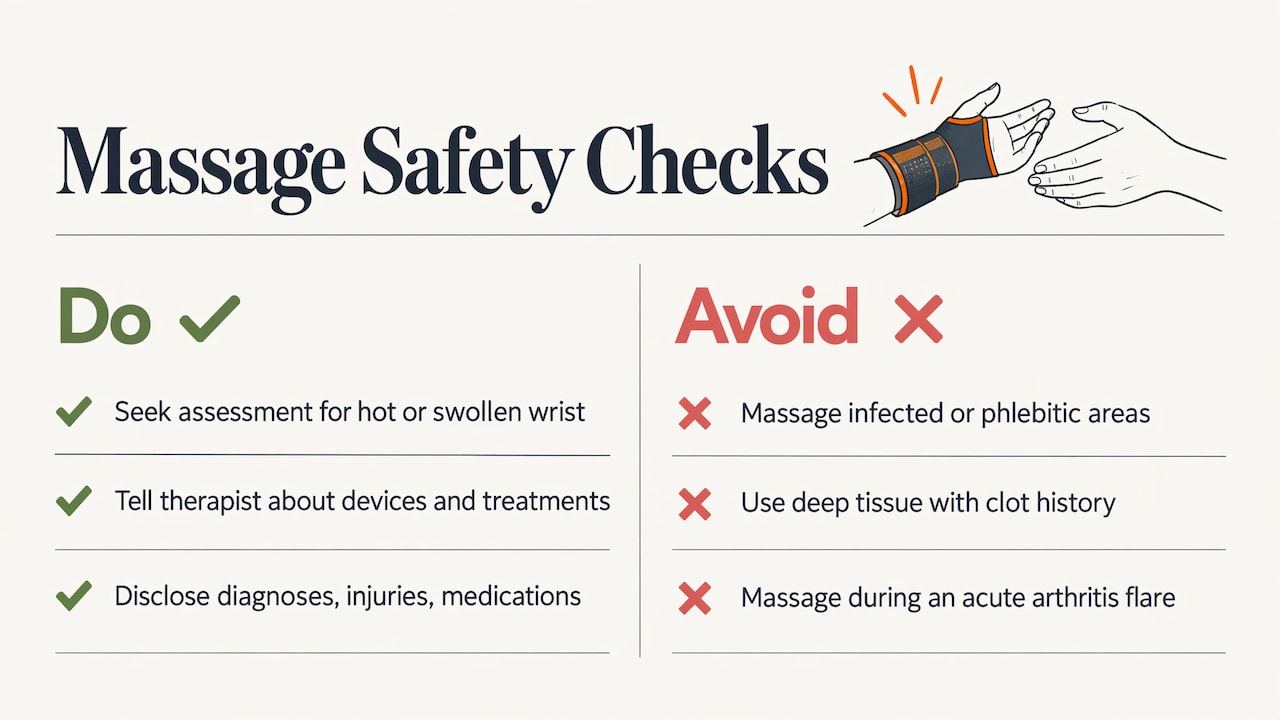
Massage is low-risk with a trained professional, and a few situations call for adjustment or a medical check first. Johns Hopkins Medicine notes that deep tissue massage may not be advised for frail older adults, people with a history of blood clots, people with severe rheumatoid arthritis, and in some cases people with a history of physical abuse or trauma. It also recommends telling your therapist about implanted devices and all treatments you receive, so care is coordinated.
A clinical guideline on therapeutic massage, revised in 2026, lists these as reasons not to massage the affected area: an acute inflammatory arthritis flare, infection, cysts and phlebitis (inflammation of a vein). It lists acute inflammation, chronic arthritic conditions, bruising, pitting edema and joint instability as reasons for extra caution locally.
In plain terms: if your wrist is hot, swollen or newly bruised, wait for a medical assessment. Tell your therapist about any diagnosis, injury or medication at the start of the session so the plan fits you.
When to see a clinician before booking massage
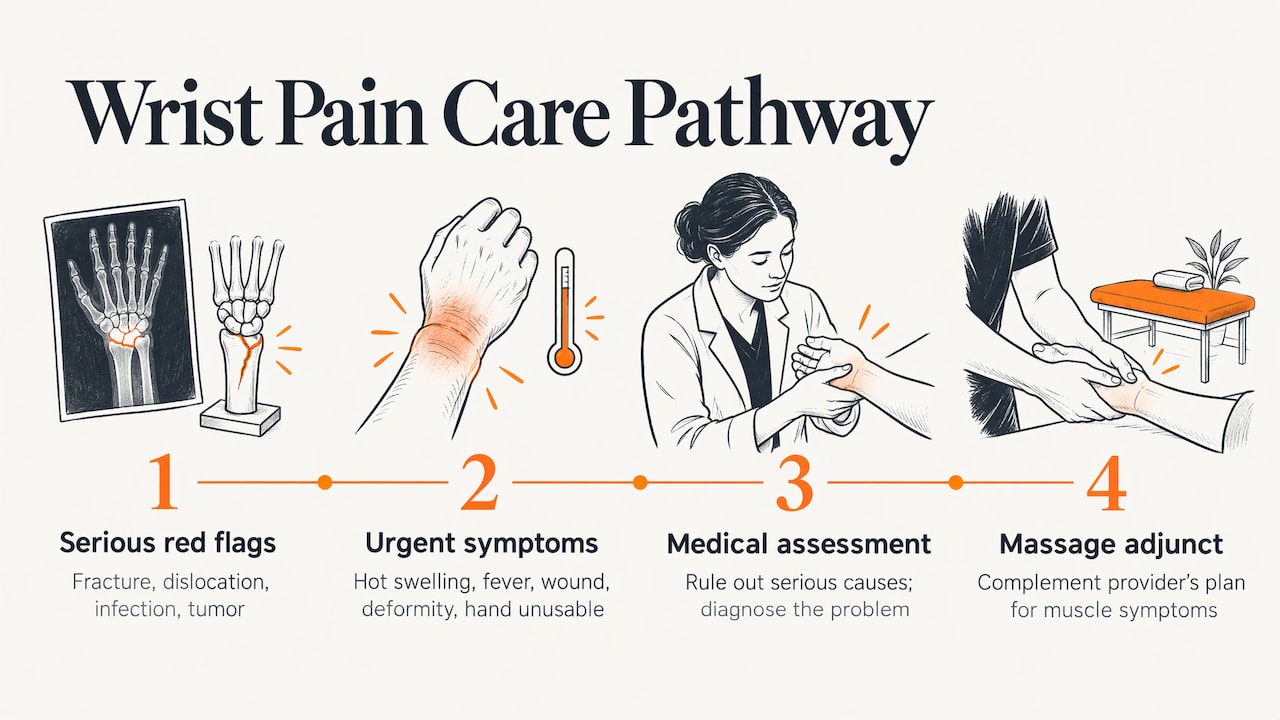
Some wrist pain is not a muscle problem. Cleveland Clinic advises seeking medical attention for signs of a fracture or dislocation, pain that limits movement or daily activities, a swollen or bruised wrist, or symptoms that do not improve after two to three weeks of exercises. It also advises seeing a healthcare provider if pain runs higher than 3 or 4 out of 10.
The ACOEM guideline lists fracture, acute dislocation, infection, neurovascular compromise and tumor as the potentially serious conditions, and recommends early consultation with a hand or upper limb specialist or a rheumatologist when red flags appear. A sports medicine physician’s guide on De Quervain’s tendon pain lists same-day care triggers: a hot, red, rapidly swelling area, fever, an open wound, new deformity, or being unable to use the hand.
For a minor strain, Mayo Clinic describes self-care with ice and an elastic bandage wrap, and says people may be referred to an orthopedic surgeon, a physical medicine and rehabilitation specialist, a sports medicine specialist, or a rheumatologist when arthritis is suspected.
Once a medical provider has ruled out the serious causes and diagnosed the problem, massage can be a useful companion to their plan for the muscle side. Bring that diagnosis to your session.
A worked example: the desk worker with a sore right wrist
Picture someone who types and uses a mouse for eight hours. The ache sits at the back of the right wrist and creeps into the forearm by afternoon. There is no swelling, no numbness, and it eases overnight.
That pattern points to overworked extensor muscles. A sensible plan: rearrange the workstation so the wrist stays neutral, do the gentle stretches above, use light self-massage in the evening, and book a session for the deeper forearm work. In the session, a therapist would likely focus on the forearm extensors and flexors, the thumb base and the shoulder girdle, and check in on pressure often. If tingling began to show up or the ache did not ease within a few weeks, the next step is a medical visit, not more pressure.
Book wrist and forearm work in Austin
We offer Swedish and deep tissue sessions at $120 to $245, and sports massage at $120 to $145, in our studio or at your location through mobile service. Trigger point therapy and stretching with joint mobilization are also available. See the full list of massage services in Austin and choose the format that fits your week.

Tell us at booking where it hurts, what you do all day and any diagnosis you have, and we will plan the session around the forearm, hand and shoulder that feed your wrist.
Perspective
Our view is simple: a sore wrist is rarely only a wrist problem. When someone comes in with an ache at the joint, we look up the arm. The forearm muscles, the elbow, the shoulder and even how you sit all change what the wrist has to put up with.
That is why communication runs through every session. Pressure on a tight forearm should feel productive, never like something to endure, and we adjust as you tell us what you feel. Rick draws on his healthcare background and his own athletic experience to read what the tissue is doing and to keep you comfortable while he works.
We also want you to leave with a plan that outlasts the hour: how to set up a desk, which gentle stretches to use, and when a symptom belongs with a medical provider. Our deep tissue, trigger point and myofascial work is designed to take tension out of the muscles that load your wrist, so everyday movement feels easier.
Operations
FAQ
Does massage help wrist pain?
It can help when the pain comes with tight forearm muscles, trigger points or stiff soft tissue, which is common after repetitive work or training. The ACOEM 2025 guideline recommends massage for carpal tunnel syndrome with forearm myofascial pain. A medical provider should diagnose the cause first if you have numbness, swelling or an injury.
How hard should I press when massaging my own wrist?
Use light pressure to start, then moderate pressure on tender spots in the forearm, around a 3 or 4 out of 10. Avoid pressing directly on the bony parts of the wrist. If tingling, numbness or sharp pain increases, stop.
Can I get a massage if I have carpal tunnel symptoms?
Yes, in many cases, once a medical provider has confirmed the diagnosis. Massage is aimed at the forearm and hand muscles around the nerve, and your therapist adapts pressure to what you feel. Our carpal tunnel massage guide explains this in more detail.
Should I use ice or heat before massage?
For a minor strain, Mayo Clinic describes ice and an elastic bandage wrap as self-care. Warmth before a gentle massage can make tissue easier to work for general stiffness. If the wrist is swollen, hot or bruised, see a clinician first.
How many sessions will I need?
That depends on what is behind the pain, how long it has been there and how much repetitive load continues. Many people notice how the forearm feels within a session or two, and we adjust the plan with you as you respond.
Sources
- 11 Exercises and Stretches for Wrist Pain, Cleveland Clinic
- ACOEM Hand, Wrist, and Forearm Disorders Guideline, 2025
- The effectiveness of manual therapy on pain, physical function and nerve conduction in carpal tunnel syndrome, 2021
- Carpal Tunnel Syndrome: Effectiveness of Physical Therapy, systematic review
- Massage, Johns Hopkins Medicine
- Therapeutic Massage Medical Policy/Guideline
- De Quervain Exercises, Brace, and Activity Guide
- Wrist pain: Diagnosis and treatment, Mayo Clinic